

The fourth step is where Tucker stops. Not the stairs themselves and not the landing, the fourth step from the bottom, where the light comes through the front window and lands on the oak. A 10-year-old Labrador mix needs a moment there now, deciding whether the rest of the climb is worth it. I noticed it in January. I noticed it again in March. By April I was standing behind him with my hand on his hip, waiting, feeling like a person who had been handed a warning and had decided not to read it. That is how a bag of VETRISCIENCE Extra Strength Healthy Hip & Joint chews ended up on my kitchen counter next to the coffee can.
I am not a veterinarian and I am not going to tell you a chew fixed my dog. What I can tell you is what I bought, what the label actually lists, how Tucker did over five months, and the two things about the product that still irritate me. If you are standing behind a slowing dog on a staircase right now, that is probably the part you came for.
The Quick Verdict
VETRISCIENCE puts 1000 mg of glucosamine HCl and 1000 mg of MSM into a chicken chew my dog takes without an argument, and five months in, the stairs are less of an event. It is not a cure, it is not fast, and the bag runs out sooner than you expect.
Amazon Check Today's Price →Five Months In, This Is Still the Bag on My Counter
120 chicken chewables with 1000 mg glucosamine HCl and 1000 mg MSM, sized for medium, large and giant breeds. Ask your vet about the right amount for your dog's weight first. Current price and the full listing are here.
Amazon Check Today's Price on Amazon →How I've Used It
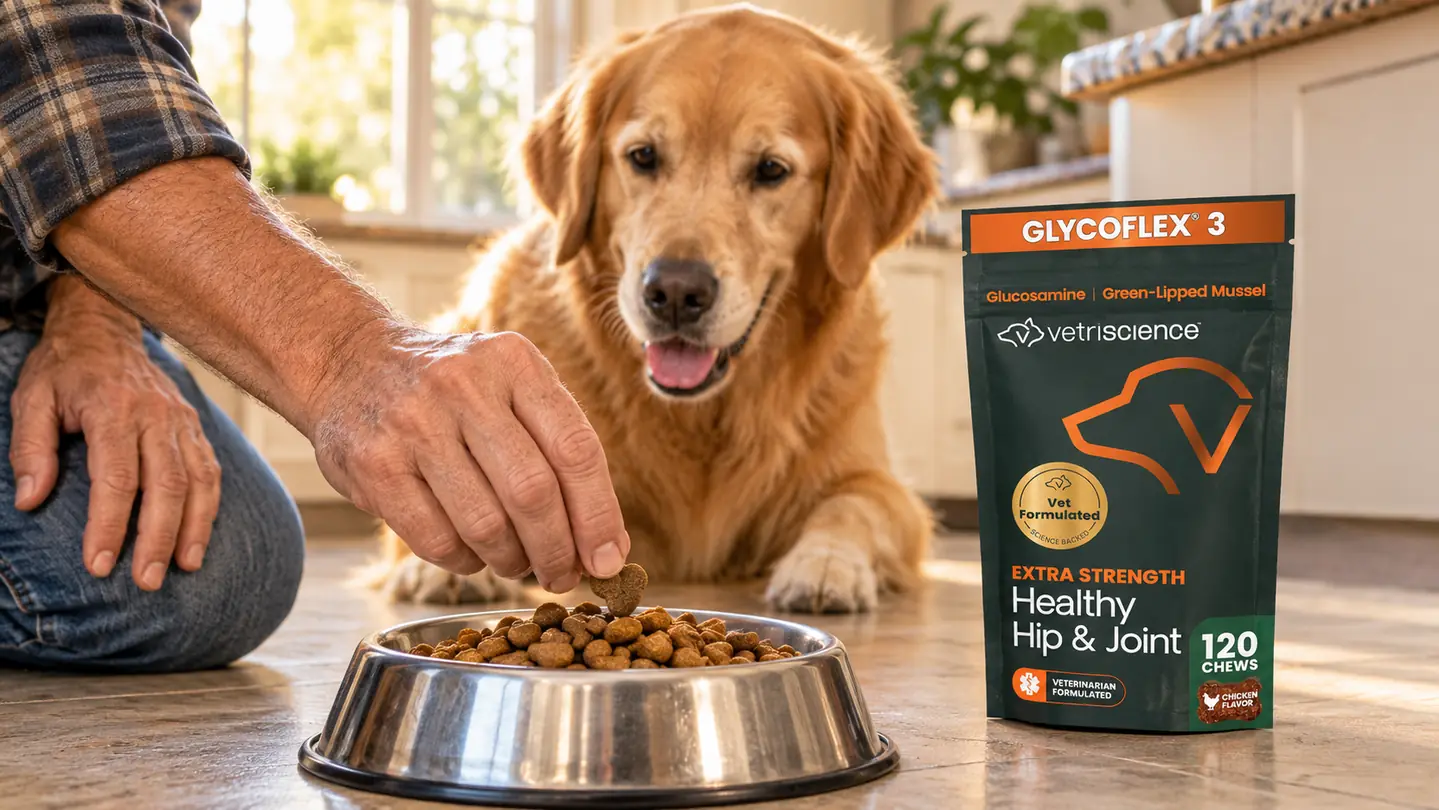
Tucker gets his chew with breakfast, dry, straight from my hand, before we go out. He is a Labrador mix and would eat a shoe if I set it in a bowl, so the fact that he takes this one without sniffing it first tells you the chicken flavor is doing its job. I never crushed it into his kibble and I never wrapped it in anything. The whole point was to find out whether the chews were palatable enough to keep the routine going for months, because a supplement you have to fight your dog over is a supplement that ends up in a drawer by the second week.
Our vet is the one who set the amount. I brought the bag to Tucker's spring visit, we went through the label together, and she gave me a number for a 70-pound dog. I want to be plain about this: the amount on the bag and the amount your vet wants can be two different things, and the second one is the one that matters. Tucker also takes a prescription anti-inflammatory on bad days, and I asked specifically whether the chews would interfere. They do not, in his case. That is not a general statement about your dog, that is his chart, and I would not carry it over to a different dog in a different house with a different diagnosis.
The VETRISCIENCE bag is 120 bite-size chews and the listing gives the package dimensions as 14 by 6.75 by 10.56 inches, which means it takes up real shelf space in the pantry rather than disappearing behind the dry food. What surprised me is how quickly 120 chews goes when you are feeding a large dog every single morning. I had built a mental picture of a three-month supply and it was not that. Set a reminder on your phone the day you open the bag, or you will be scraping the bottom on a Tuesday morning with a dog staring at you and no plan.
What Is Actually in the Bag
This is the Extra Strength version of the VETRISCIENCE Healthy Hip & Joint formula, and it is a separate product from the regular Healthy Hip & Joint line. The label lists glucosamine HCl at 1000 mg and MSM at 1000 mg. It also lists Perna canaliculus, which is green-lipped mussel, and DMG. The two bags sit close together on a shelf and look similar enough that I checked the label twice before I ordered. If you are comparing, look for the words Extra Strength before you click, because the regular bag will not give your large dog the same numbers.
Glucosamine and MSM are the two names you will see on nearly every joint product for dogs, and here they are printed as numbers instead of buried inside a blend. That matters more than it sounds. When a label says joint support complex 1500 mg and then lists six ingredients underneath with no separate figures, you have no idea what your dog is actually getting in a day. On this bag you can read the number sitting next to the name, which is the only reason I was willing to hand it to a dog I have had since he was eight weeks old.
The green-lipped mussel and the DMG are why I picked this over the plain glucosamine chews I looked at first. The listing describes the benefits as antioxidant support, hip and leg strength, joint health and mobility support. Whether the mussel and the DMG are doing much on top of the glucosamine is not something I can measure in my kitchen with one dog. I can only tell you what I decided, which is that I would rather buy the formula with more in it than the one with less, provided my dog would actually eat it. A bag of excellent ingredients in the pantry is worth nothing.
What is not in the bag is anything for pain. This is not a painkiller and it does not behave like one. It is a daily supplement aimed at hip and joint support, and if your dog is yelping when he stands or refusing to put weight on a leg, the bag is not the answer. Your vet is. The listing sizes the chew for medium, large and giant breeds, which fits a 70-pound dog and does not fit a 12-pound terrier without cutting chews in half. The whole bag is two pounds and it is chicken flavored, so a poultry-sensitive dog needs a different product entirely.
The First Six Weeks
Nothing happened in week one. I want to say that clearly, because the internet is full of people who report a change in four days, and either they are luckier than I am or they are selling something. Tucker ate the chews, enjoyed them, and moved exactly the way he moved before. I kept a note on the fridge and wrote the same word four days running, which was: same.
Somewhere in the third week I noticed I was not waiting on the stairs anymore. Not because he was faster, but because he was not stopping. He would get to the top, turn left into the bedroom, and lie down, and I would realize halfway through making the bed that I had not stood behind him at all that morning. That is a small thing written down on a note. In the house it was the first change in a year that went in the right direction, and I noticed it before I noticed that I had noticed it.
Here is where I have to be honest about how hard this is to judge. In the same six weeks I trimmed his nails, which changes how a dog stands, and I moved his bed downstairs so he was doing the stairs less often at night. Either of those could explain part of what I saw, and I am not going to pretend otherwise. What I can say is that nothing got worse, the morning stiffness that used to take three or four steps to walk off was down to one or two, and he started meeting me at the door again when the Outback pulled in, which he had quietly stopped doing sometime last fall.
What Changed and What Didn't
The stairs are the clearest difference. He goes up with a rhythm now instead of a pause, and he comes down without that little hitch where he used to gather himself on the landing. He also moves across the kitchen floor with more confidence than he did in February, though that may be the nails as much as anything. I keep coming back to the same sentence: I cannot separate the pieces, and neither can you, and anyone who tells you they can is guessing about their own dog too.
The car is still a negotiation. He used to launch into the back of the Outback without thinking, and about a year ago he started putting his front paws up and then looking back at me like I was asking him to jump a creek. Five months of chews has not fixed that. What changed is that when I lift his back end now, he pushes with the front instead of hanging there like a sack of flour. That is a two-person job turned into a one-person job, and I will take it without complaint.
The morning walk around the block is unchanged and the Saturday walk along the river trail is unchanged, which is the good news. The less good news is that a long car ride followed by a long walk still leaves him stiff that night. The chews did not buy Tucker more distance. They bought him easier recovery from the distance he already does, and those are not the same thing. If you are hoping to add a mile to your dog's day, this is not the lever for that, and no chew on a shelf is.

The Annoyances
My first complaint is the bag size. For a 70-pound dog on a daily chew, 120 count is not the supply I assumed it was when I ordered, and I ended up reordering earlier than planned. That is a planning problem and not a formula problem, but you should know it going in. If your dog is bigger than Tucker, do the arithmetic before you decide the bag will carry you to summer, because it will not.
My second complaint is that this only works if you are the kind of person who does the same thing every morning. There is no dramatic week where you see the payoff, no obvious moment where you would say yes, that was the chew. There is a spring where the dog stops hesitating and you slowly stop noticing it. I put a checkmark on the calendar for the first sixty days because I wanted something to look at. Two friends started VETRISCIENCE chews after me and both quit inside a month, not because it failed, but because they could not tell yet whether it was working, and quitting felt cheaper than waiting.
And one practical note. If your dog is a gulper who swallows without chewing, sit on the floor with him the first few mornings. Tucker chews his. My sister's dog does not chew anything, and a bite-size chew taken whole is a conversation with your vet about how to serve it, not a conversation with me. Also worth buying a second bag before the first one runs out, so you are never making a decision about a supplement at seven in the morning with a dog waiting by the door.
What I Liked
- Glucosamine HCl at 1000 mg and MSM at 1000 mg, printed as numbers instead of hidden inside a blend
- A chicken chewable that a food-motivated dog takes without coaxing or wrapping
- Sized for medium, large and giant breeds, which matches a 70-pound Labrador mix
- Five months in, morning stiffness walks off in one or two steps instead of three or four
- VETRISCIENCE includes green-lipped mussel and DMG alongside the glucosamine, which is why I chose it over a glucosamine-only chew
Where It Falls Short
- 120 count goes fast for a large dog on a daily chew
- No pain relief in it, so a dog in real pain needs the vet and not the bag
- You will not know whether it is working for at least a month, and probably longer
- Chicken flavored, so it is out for poultry-sensitive dogs
- The Extra Strength bag and the regular bag look alike, and buying the wrong one is easy
Five months in, the morning stiffness that used to take three or four steps to walk off takes one or two, and he meets me at the door again.
Who This Is For
This is for the owner of a middle-aged or older dog who is slowing down in a specific, visible way. Stiff getting up in the morning. Slower on the stairs. Hesitating at the back of the car. A dog who still wants the walk but takes longer to get ready for it. It is also for the person who has already had the obvious things checked by their vet and wants to add a daily joint supplement with readable amounts on the label rather than a mystery blend. VETRISCIENCE sizes this for medium, large and giant breeds, so it fits the 60 to 90 pound dogs that make up most of the slowing-down cases I know, and the chicken flavor is the reason mine takes it without a fight.
Who Should Skip It
Skip it if your dog is limping, yelping, refusing to put weight on a leg, or has suddenly gone off his food. That is a vet visit this week, not a supplement on a pantry shelf. Skip it if your dog has a poultry allergy, since this is a chicken chew. Skip it if you already know in your heart that you will not keep up a daily routine for two months, because you will spend the money, quit in week three, and blame the product for a decision that was never really about the product. And skip it if you are looking for something fast. Nothing about this is fast, and the dogs that do best on it are the ones whose owners were willing to be boring about it for a season.
If Your Dog Is Stopping on the Fourth Step, Start Here
120 chicken chewables with 1000 mg glucosamine HCl and 1000 mg MSM, plus green-lipped mussel and DMG, sized for medium to giant breeds. Talk to your vet about the amount for your dog's weight before the first chew, then check today's price.
Amazon Check Today's Price on Amazon →