
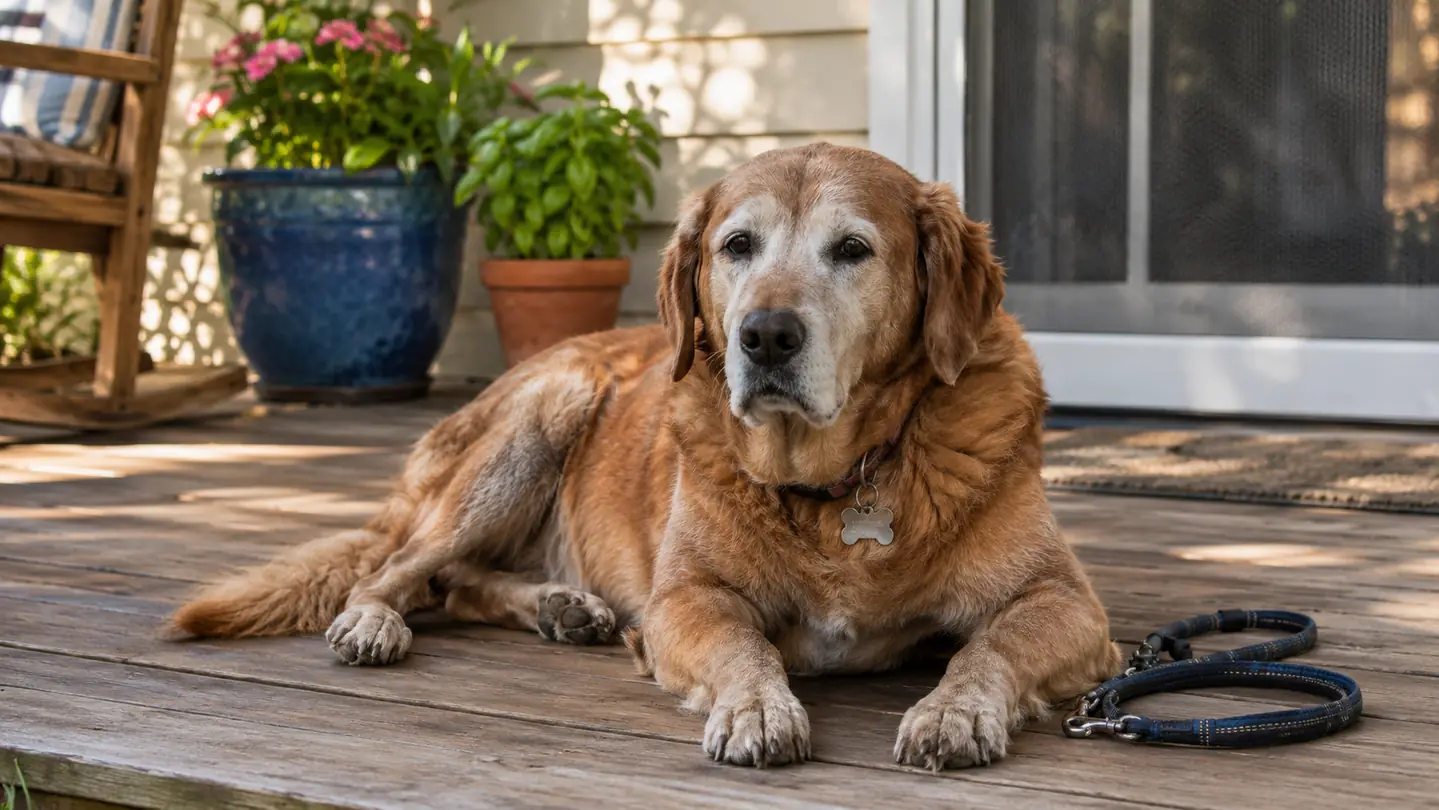
Tucker started hesitating at the back of my Subaru Outback about a year ago. He is a 10-year-old Labrador mix, about 70 pounds, and for most of his life he launched himself into that cargo area like it was nothing. Then he began to pause, look at the bumper, look back at me, and wait for a lift. Around the same time, the stairs to our bedroom in St. Paul got slower. He was stiff when he got up in the morning, not lame, just rusty. Our vet called it early stiffness and told me to keep him lean, keep him moving, and consider a joint supplement. I asked what brand she saw most often. She named Cosequin Maximum Strength from Nutramax Laboratories.
I have now used it daily for a little over six months. This is not a dramatic story. Tucker did not leap like a puppy again, and I would be suspicious of any supplement review that claimed that. What I can tell you is what changed, what did not, and what I wish someone had explained to me before I started. If you are standing in your kitchen with a stiff older dog and a bottle of chewable tablets, that is the conversation I want to have.
The Quick Verdict
A vet-recommended joint supplement with clear ingredient amounts and a tablet Tucker takes without a fight. It is not a painkiller, and it took months, not days, before I trusted what I was seeing.
Amazon Check Today's Price →The Joint Supplement Our Vet Named First
Cosequin Maximum Strength combines glucosamine, chondroitin, MSM, and hyaluronic acid in a chewable tablet. It is the bottle that stayed on our counter after the first month. Check the current price and count on Amazon.
Amazon Check Today's Price on Amazon →How I've Used It
Tucker gets his tablet with his morning meal. That is the whole routine. I keep the bottle in the cabinet beside the kibble, and because he is food-motivated, he takes it like a treat. I know that sounds easy. It is easy for us. A picky dog may not agree, and I will come back to that.
I confirmed the amount with our vet before we started. I did not change his food, his walk schedule, or his bedding at the same time. That was deliberate. If I had changed three things at once, I would not know what was helping. For six months, the only new variable was the tablet.
Our routine is a morning walk around the neighborhood and a longer weekend walk along the river trail. I used those walks as my measuring stick. Not a stopwatch, not a phone app, just the same two routes and the same question: does he lag on the way home, and does he take the stairs without that long pause? The bottle is 75 chewable tablets, 6.4 ounces, and 5.21 inches tall, so it fits on a shelf without taking over.
I tried two other things before this bottle. The first was a glucosamine powder I mixed into his wet food. Tucker ate the food and left a gritty ring in the bowl, and I never knew how much actually got into him. The second was a soft chew he liked for about a week and then started dropping on the rug. Neither one was a fair test of anything. A supplement only works if it goes in the dog every day, and both of those failed that first test. The tablet is the first version of this that Tucker treats as part of breakfast.
What Is in the Tablet and Why It Matters
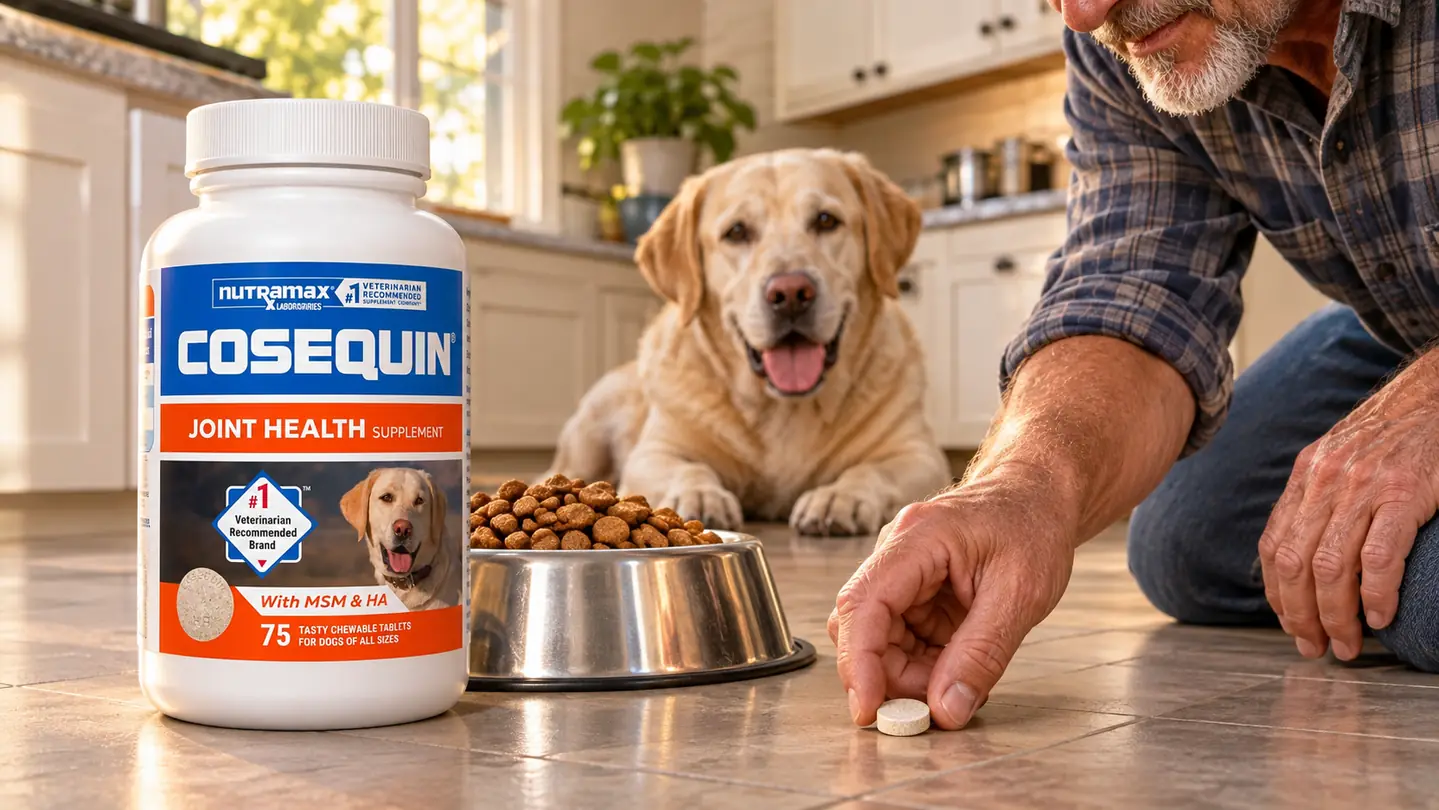
The label lists glucosamine hydrochloride at 600 mg, sodium chondroitin sulfate at 300 mg, MSM, and hyaluronic acid. Those are the ingredients I look for in a joint supplement, and they are listed with amounts, not buried in a proprietary blend. Glucosamine and chondroitin are the pair most often discussed for cartilage support. MSM is included for joint comfort, and hyaluronic acid is there for joint fluid. I am not a veterinarian, and I am not going to pretend those ingredients work the same way for every dog.
What I appreciate is that the amounts are on the label. I can hand the bottle to our vet and ask a direct question. That is harder to do with a powder that lists a blend and no numbers. Nutramax Laboratories has been in pet health for over 25 years, and Cosequin is described as the number one vet recommended retail joint health supplement brand. That does not make it right for every dog, but it is why I started there instead of guessing.
The tablet form matters more than I expected. I have tried powders that Tucker turned his nose up at, and I have tried chews that crumbled in my pocket. A chewable tablet is simple to store and simple to hand over. The listing also says allergen-free. I still read labels, because allergen-free is a claim about the product, not a promise about your individual dog.
The bottle itself is small. The listing gives it as 6.4 ounces and 5.21 inches tall, which is roughly the size of a large spice jar. It sits on the shelf beside the kibble without taking over the cabinet, and the cap is easy to open with one hand while a dog is circling your feet. I keep it out of the sunlight and away from the stove, which is what I do with all of our supplements. The tablets hold up fine at room temperature in a Minnesota kitchen, including the humid weeks in July.
The First Six Weeks: What Changed and What Didn't
For the first two weeks, nothing. I want to be clear about that because I have read reviews that make it sound like the dog was different by Tuesday. Tucker was the same dog. He got up slowly, he took the stairs slowly, and he still needed a boost into the Outback. I kept a note on the refrigerator and wrote down one thing each day: how he rose from his bed, how he did on the stairs, and whether he lagged on the second half of the walk.
Around week three, I noticed a shorter pause at the bottom of the stairs. Not a faster climb. Just less standing and staring before he started. Around week five, he began to push himself up from his bed without that low groan. I do not know if that was the tablet, the warmer weather, or both. Twin Cities springs are unpredictable, and I am not going to credit a supplement for the sun.
Here is the part I have to be careful about. I started the bottle on a Monday in early March, and the first four weeks were cold and icy, so our neighborhood loop was shorter than usual. I had a second explanation for everything I saw. By mid-April the ice was off the sidewalk and we were back to the full route. That was the week I stopped second-guessing my own notes. Same loop, same distance, same dog, and he was finishing it with his head up instead of dragging toward the corner. That is not proof of anything. It is a pattern I could see with my own eyes on a route I have walked a thousand times.
The back of the Outback stayed a negotiation. He still waits for me to pat the bumper. That has not changed, and I am fine with it. Lifting a 70-pound dog is not good for my back, but neither is pretending he is a puppy. I bought a folding ramp and he ignores it. That is a separate problem.
Six Months In: The Small Stuff I Notice Now
The biggest change is not a single moment. It is the morning walk. Tucker used to plod through the first block and pick up speed only when we turned for home. Now he trots for the first stretch. Not every day. On humid mornings he is still stiff, and on the day after a long river trail walk he is slower. But the baseline is better than it was in March.
The stairs are still slower than they were when he was six. I want to say that plainly. He goes up one step at a time, and sometimes he stops on the landing. The difference is that he does not hesitate at the bottom anymore. He starts. For a 10-year-old Lab mix, that is the win I was looking for.
There was one Sunday in August when I noticed it without looking for it. We were about a mile into the river trail and a jogger came up behind us. Tucker used to ignore that entirely. That morning he stepped to the edge of the path, turned to watch the jogger pass, and then picked up the same pace he had before. It is a small thing to describe. But a dog whose hips are sore does not bother to turn around. I wrote it on the note that night and did not think about it again until I sat down to write this.
He has held at 70 pounds since March on the clinic scale. That matters more than it sounds, because every extra pound is a pound his joints carry up those stairs twice a day.
Our vet checked him at the six-month mark and said his muscle tone was good and his weight was steady. She did not wave a wand and declare him arthritis-free. She said to keep doing what we were doing and to come back if the stiffness got worse. That is the honest version of a supplement review. It is one tool in a larger plan.

The Tradeoffs Nobody Mentions
Cosequin is not a painkiller. If your dog is limping, holding up a leg, or crying when he stands, that is a vet visit, not a tablet from Amazon. I would not use this review to delay a diagnosis. Tucker's stiffness is mild and chronic. That is the dog this product fits.
It is also a daily commitment. Miss a day and you do not ruin anything, but the point is consistency. I put the bottle next to the coffee maker so I see it before I see my phone. If you travel a lot, you need a pill organizer or a second bottle in the car. The 75-count bottle is not huge, and it will not last forever.
Some dogs will not take a tablet. Tucker is easy. Your dog may be the one who eats the kibble and leaves the tablet on the floor. You can crumble it, hide it in wet food, or ask your vet about another form, but do not force it. A dog that dreads breakfast is not getting much benefit. And if your dog has food allergies or is on other medications, talk to your vet before you add anything.
One thing on the label is worth flagging. The listing describes this tablet for medium breed sizes, and Tucker at 70 pounds sits right at the top of that range. That is exactly why I asked our vet to confirm the amount rather than following the bottle on my own. If your dog is much larger or much smaller, the answer may be different, and the person who should give it is your vet, not a review on the internet. Nutramax prints the amounts clearly, which makes that conversation short, but it is still a conversation.
What I'd Ask Your Vet Before You Start
First, ask whether the stiffness is arthritis, a soft tissue injury, or something else. A supplement is not a diagnosis. Second, ask about the dose for your dog's weight and whether the Maximum Strength tablet is the right fit. Third, ask how long you should trial it before you decide. My vet said eight to twelve weeks, and that matched my experience. Fourth, ask what to measure. I used stairs, the first block of the morning walk, and how he rose from his bed. Pick two things and write them down.
Pick two things you will actually notice. Mine were the bottom of the stairs and the first block of the morning walk. I did not try to measure range of motion, because I would have gotten it wrong and then argued with my own notes. If you want something objective, ask your vet to watch your dog walk at the next visit and say what she sees. That gives you a starting line, and most people skip it.
One more question: what else should change? For Tucker, the answer was weight, shorter walks on hot days, and a rug at the bottom of the stairs so he is not sliding on hardwood. The tablet did not replace any of that. It sat on top of it. If you are looking for a single product that fixes everything, you are going to be disappointed by every supplement on the shelf.
What I Liked
- Vet recommended brand, which made the first decision easier
- Glucosamine, chondroitin, MSM, and hyaluronic acid are listed with amounts
- Chewable tablet is simple to store and give
- 75-count bottle fits in a cabinet
- Tucker showed less hesitation on the stairs by month two
- Nutramax Laboratories has been in pet health for over 25 years
Where It Falls Short
- Not a painkiller and not a substitute for a vet diagnosis
- Took weeks before I noticed anything
- Daily commitment, easy to forget on busy mornings
- Picky dogs may refuse the tablet
- Still need weight control, exercise, and a safe house setup
- 75-count bottle does not last indefinitely
By month four, Tucker was standing up from his bed without the long groan. The stairs are still slower. That is the honest scorecard.
Who This Is For
If you have an older dog with mild, chronic stiffness and your vet has cleared a joint supplement, Cosequin is a reasonable place to start. It suits owners who will give it every day and measure small changes over months. It also suits dogs like Tucker, food-motivated and willing to take a chewable tablet. If you want a bottle that matches what many vets reach for first, this is that bottle.
Who Should Skip It
Skip it if your dog is lame, swollen, or in obvious pain. Skip it if you have not had a vet look at the problem. Skip it if your dog has a sensitive stomach or food allergies and you have not checked the label with your vet. Skip it if you want a fast fix and will stop after ten days. And skip it if the daily routine is unrealistic in your house. A supplement only works when it is actually given.
If Your Vet Says Joint Supplement, Start With the One Vets Name
Cosequin Maximum Strength has the ingredient amounts on the label and a tablet form that is easy to keep on the counter. It is not a cure. It is a daily tool for a stiff older dog, and it is the one Tucker stayed on.
Amazon Check Today's Price on Amazon →