
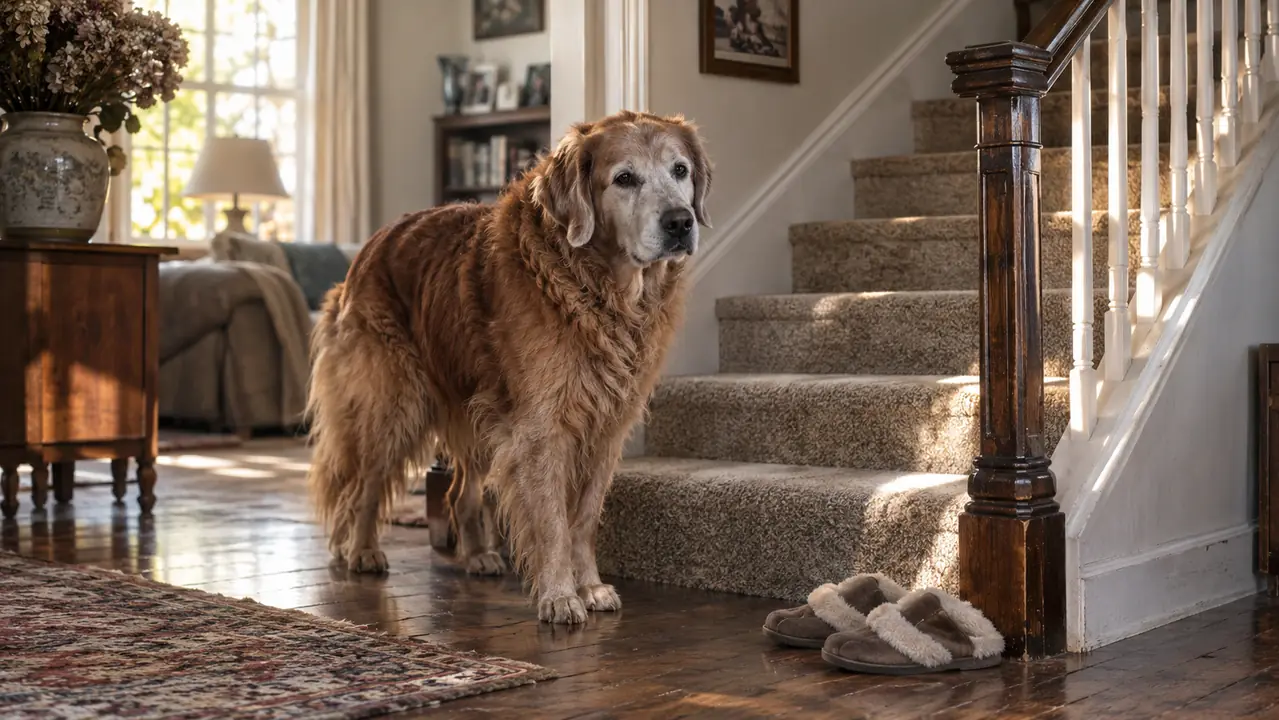
The stairs are what got me. Tucker is ten now, a seventy-pound Lab mix, and for about a year he had been doing this thing at the bottom of our staircase where he would stop, look up, and consider the whole proposition before committing. One paw on the first step. A pause. Then the rest of him. It was not a limp. It was a negotiation.
I did what most of us do first. I decided he was just getting older. Then I decided his food was the problem. Then I bought a memory foam bed that cost more than my first car, which he ignored for six weeks in favor of the rug. I had also read about VetriScience Extra Strength Healthy Hip & Joint months earlier and closed the tab, because buying a joint chew felt like signing a paper that said my dog was old. That is not a reason. That is just avoidance with a nice label on it.
What finally got me moving was a regular checkup. Our vet moved his hips through their range, watched him walk away and back, and said the words I had been half expecting: mild changes in the hip joints, nothing dramatic, and this is the age where a daily routine starts to matter. She was clear that a supplement would not reverse anything. She was also clear that keeping him comfortable and keeping him moving were both worth real effort, and that a glucosamine-based chew was a reasonable place to start.
I went home and read labels for an entire weekend. That is how I ended up back on the page I had closed months before, ordering the chicken chew form of VetriScience Healthy Hip & Joint. Not because of a headline. Because the amounts were printed plainly on the container, and because our vet nodded at the ingredient list rather than squinting at it.
I want to be honest about the shape of this story before you read another line. This is not a before and after. Seven months in, Tucker still takes his time on the stairs. What changed was smaller and more useful than that, and it is the kind of change you only notice because you live with the dog.
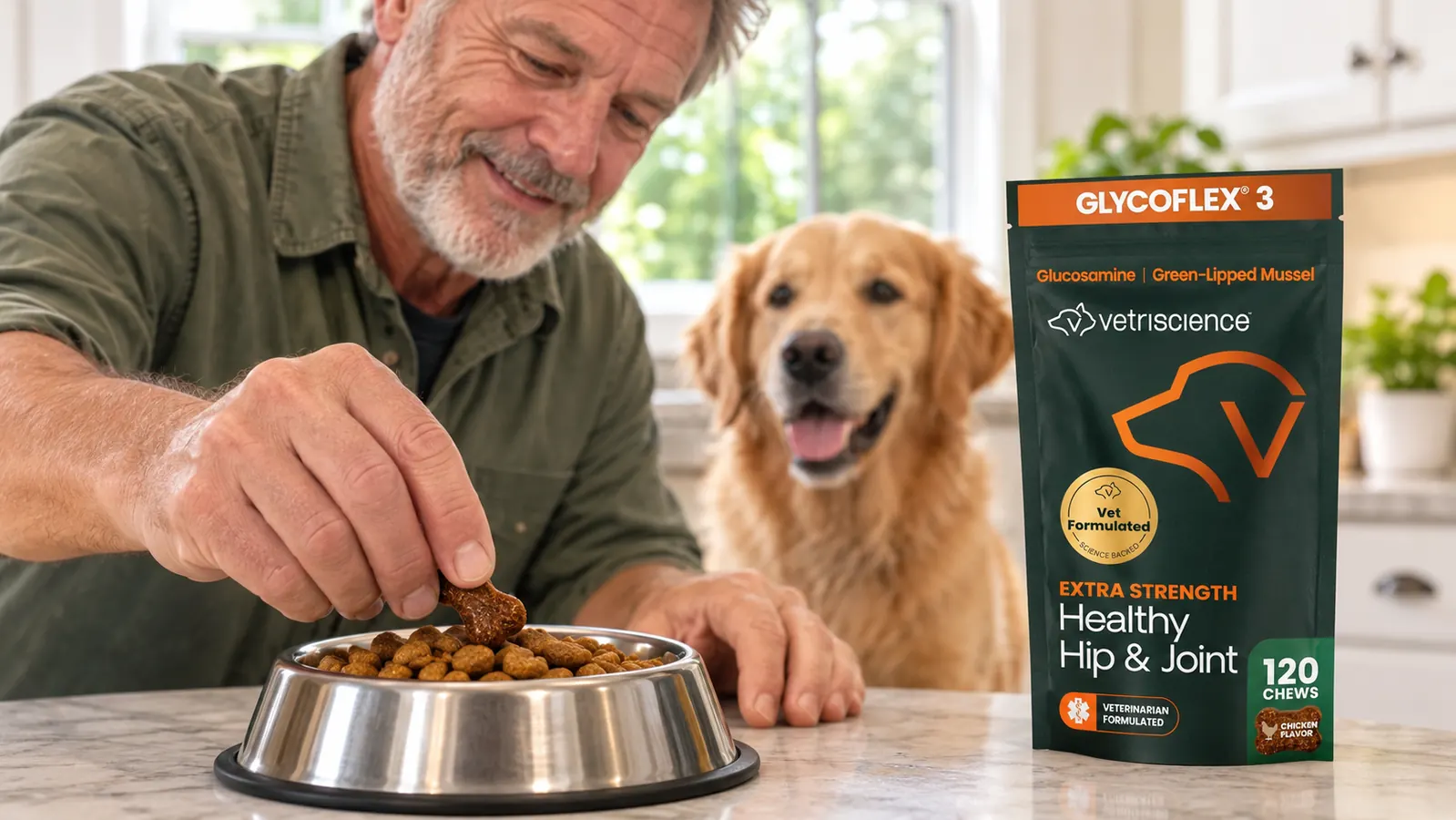
The chew Tucker gets every morning, before the walk
VetriScience Extra Strength Healthy Hip & Joint combines glucosamine, MSM, DMG and green-lipped mussel in a chicken chew formulated for medium, large and giant breeds. 120 chews per container, roughly four months at one a day for a 70-pound dog.
Amazon Check today's price on Amazon →The First Month, Which Was Mostly Nothing
Here is the part nobody writes about. Weeks one through four, I could not tell you a thing. He ate the chew, which was itself a small relief because he has refused plenty of things that were supposed to be good for him. He did not turn his nose up at the smell, which is a real consideration with green-lipped mussel in the mix.
I kept a note on the fridge, mostly so I would stop guessing later. Date, whether he hesitated at the stairs, and how the morning walk went. The first month of that note is a column of the word fine. Fine, fine, fine, fine, one day of stiff, fine.
If I had stopped there I would have told you it did not work. This is the trap with anything that supports a joint rather than numbing a symptom: there is no moment. There is only a slope you cannot see while you are standing on it.
The Thing I Actually Noticed
Somewhere in the second month, the negotiation at the bottom of the stairs got shorter. That is the entire finding. He still pauses. He just does not stand there deliberating like a man reading a lease. He looks, and then he goes.
The other change was on the weekend walks. We do the river trail, and Tucker has a habit of finding a smell and then standing over it with the intensity of a museum guard. For the past couple of years, the last quarter mile home had gotten slow. Not stopped. Slow. By month three, the slow part was shorter.
He still pauses at the bottom of the stairs. He just does not stand there deliberating like a man reading a lease. He looks, and then he goes.
The jump into the back of the Outback is still his least favorite thing in the world. He does it, and he does it with less circling beforehand than he used to, but I would be lying if I told you this chew fixed the car. Getting into a vehicle is a lot to ask of a ten-year-old hip. I lift the tailgate and let him take his time.
What I can tell you is what did not happen. No upset stomach. No refusal after the first week, which is when dogs often change their minds about a new chew. No change in his appetite or his water. That matters to me more than a dramatic story would.
What Is Actually in It
The label lists glucosamine HCl at 1000 mg and MSM at 1000 mg, plus DMG and Perna canaliculus, which is green-lipped mussel and shows up in a lot of joint formulas as a natural antioxidant source. The container calls it a chicken chew and lists the flavor plainly. VetriScience formulates this one for medium, large and giant breeds, which is part of why I looked at it for a seventy-pound dog instead of cutting a small-dog chew in half and hoping.
It is not a medication. It does not do what a prescription anti-inflammatory does, and if your dog is in genuine pain, that is a conversation for your vet and not for a chew. What it is, in plain terms, is a daily habit that supports the joint instead of masking it.

The Money Conversation
A 120-count container lasts roughly four months at one chew a day for a dog Tucker's size. I checked today's price before writing this and did the division because I am the kind of person who does the division. It lands in the range of what I was already spending on the bed he refuses to sleep in, and unlike the bed, he uses this every single morning.
If that math does not work for your household, that is a real answer and not a failure. Joint support is one of the few areas where the routine matters more than the brand. Whatever you choose, put it next to the food bowl and give it at the same time every day, because a supplement you forget is a supplement that does nothing.
Four months of mornings for one container
If your dog is at the age where the stairs have become a conversation, this is the version I landed on after a weekend of label reading. Chicken chews, 120 count, formulated for large dogs.
Amazon See the current price on Amazon →Two things I would say to anyone starting this. First, get the vet to look at your dog before you buy anything, because stiffness in a ten-year-old Lab can come from a hip, a knee, the spine, or simply from a body that has lost some muscle. The plan is different depending on the answer, and a chew is not a diagnosis.
Second, weigh your dog and dose to the label. Tucker is about seventy pounds and one chew a day is what his container calls for. Guessing at dosage because the chew looks small is how people end up disappointed by something that was working fine at the right amount.
We are seven months in. He is not a puppy. He will never be a puppy again, and I have made my peace with that. But the morning walk is longer than it was last spring, and the staircase has stopped being an event. For a dog who is ten, that is a good season.
What I'd Tell You If We Were Sitting at My Kitchen Table
I would tell you not to expect a transformation, and I would tell you not to expect nothing either. I nearly quit at week four because I could not see anything, and the only reason I did not is that a friend who has an older dog told me to give it three months and keep the note on the fridge.
I would tell you that the stairs are the tell. Not whether your dog can do them, but how long he stands there before he does. Watch that for a month. That is the number that matters, and it is the one nobody sells you.
I would also tell you that the first vet visit is the cheapest part of this whole thing and the most useful. I spent a weekend reading labels and a hundred afternoons second-guessing myself, and the answer I actually needed came from ten minutes in an exam room with someone who could feel what I could only guess at.
And I would tell you that a joint routine is not one thing. It is the chew, and the weight, and the shorter walks on the hot days, and the rug at the bottom of the stairs instead of the bare wood, and the vet visit twice a year. VetriScience is one line in that list for us, not the whole page. It earned its place. But you are the one who has to keep the list.
If your dog is where Tucker was a year ago, hesitating at the bottom of the stairs and slowing on the last quarter mile, then start with your vet, start with the note on the fridge, and start now rather than at eleven. You will not get a dramatic story out of it. You will get a dog who looks at the stairs and then goes up them, which turns out to be the whole thing.