

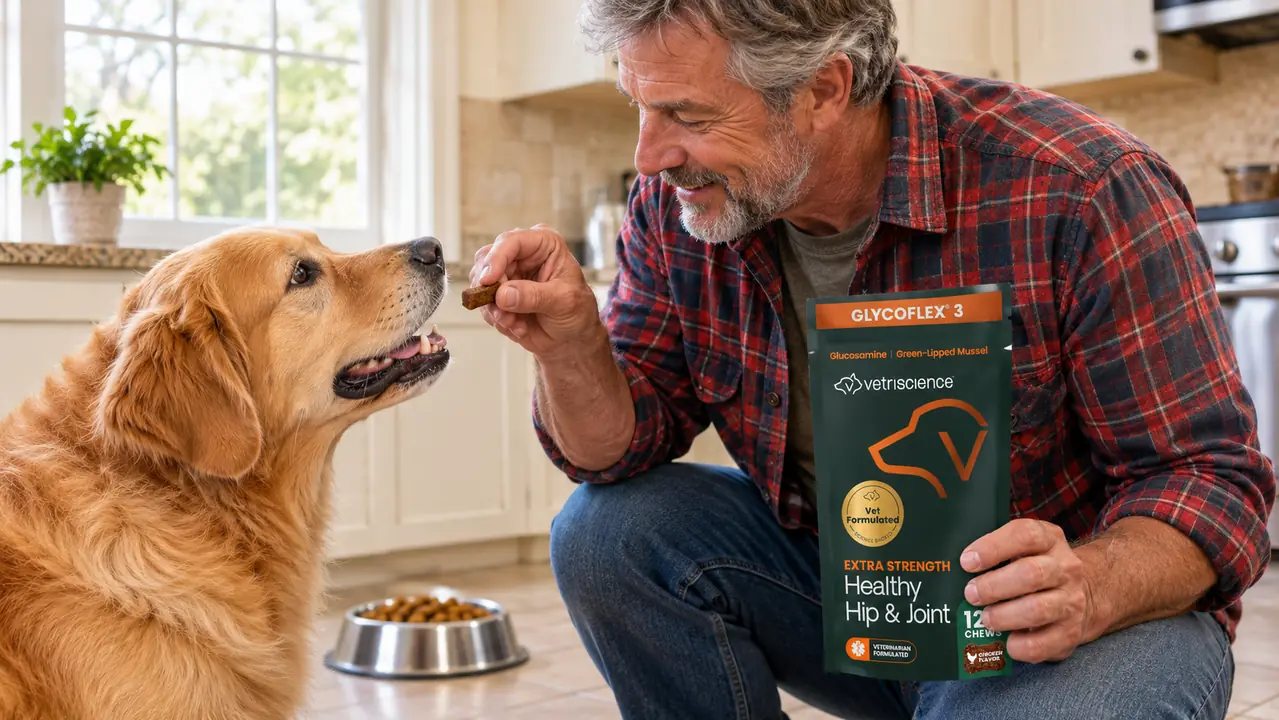
Tucker is ten years old, a Labrador mix, about seventy pounds, and for most of his life he cleared the back of my Subaru Outback in one motion. About a year ago he started stopping first. He would stand at the tailgate, look at it, and do the jump in two parts. That pause is why I started reading the small print on joint chews, and why there is now a bag of VETRISCIENCE Extra Strength Healthy Hip & Joint chews sitting next to the coffee maker in my kitchen.
Here is what I am not going to tell you: that a chew turned my old dog back into a puppy. It did not. What changed, slowly, over about eight weeks, was the size of his bad days. The get-up took one try instead of three. The stairs to the bedroom stopped being a negotiation. Below are ten reasons those chews earn their spot on the counter, in plain kitchen-table language, with a short section at the end about what they will not do. Ask your vet before you start anything, including this.
The bag that got Tucker through the winter mornings
VETRISCIENCE Extra Strength Healthy Hip & Joint, chicken chews, 120 count. Glucosamine, MSM and green-lipped mussel in a bite-size chew built for medium, large and giant dogs.
Amazon Check Today's Price on Amazon →The morning get-up takes one try instead of three
Stiffness after sleep is the first thing most owners notice, and it was the first thing I noticed in Tucker. Each chew carries 1000 mg of glucosamine HCl, the ingredient most joint formulas are built around. I am not going to pretend I could feel a difference in week one. Somewhere around week six, the number of tries it took him to stand up off the rug in the front room started dropping. That is the whole claim, and it is enough for me.
MSM at 1000 mg covers the stiffness that shows up after exercise
Most labels lead with glucosamine and stop there. These chews also carry 1000 mg of MSM per chew. That is the piece I look for when a dog is stiff after a long walk rather than just after sleep. Tucker is slower on Sunday evening than he is on a Tuesday, and that pattern was the one I watched most closely. The previous chew we tried was glucosamine only, and it never seemed to touch the after-exercise version of stiff.
Green-lipped mussel is a real ingredient here, not label decoration
The panel lists Perna canaliculus, which is green-lipped mussel, and the product benefits call out antioxidant support alongside hip and leg strength. Plenty of cheap chews print a long ingredient list and put almost none of it in the bag. This one is vet-formulated and it states what it states at the amounts it states. If you have ever stood in an aisle holding two bags and wondering why they are not the same thing, this is the paragraph that answers it.
Bite-size chews mean a seventy-pound dog does not fight you
Tucker is a Labrador mix at about seventy pounds and he is not a delicate eater. A big hard tablet gets chewed once, dropped, and forgotten under the radiator. These are bite-size chicken chews, and he takes one the way he takes a treat, which means I actually give it instead of negotiating at seven in the morning. That sounds like a small thing. It is the difference between a supplement that gets used and one that quietly expires in a cupboard.
Chicken flavor means no peanut butter tax
Anyone who has hidden a pill in a spoon of peanut butter knows how that goes. It works for a week, then the dog figures out the trick and starts eating around it. These are chicken chews with a flavor a dog will take on its own. Tucker gets his on top of breakfast and now sits by the bowl early, which is a small daily pleasure I did not expect. No bribe, no crushed tablet in wet food, no wondering whether he got the whole thing.

A 120-count bag is long enough to actually judge it
Joint changes are slow and a seven-day sample tells you nothing. VETRISCIENCE puts 120 chews in the bag, which is enough to run a real trial instead of a long weekend. That matters more than any line on the front of the package, because the honest answer to does this work is not in four days. Give it the length of the bag before you decide, and write down today what your dog looks like so you have something to compare against.
It is built for large dogs, not scaled up from a toy breed
The breed size listing covers medium, large and giant dogs. That matters, because a chew formulated for a fifteen-pound dog and fed to a seventy-pound dog is mostly hope and chicken flavor. Tucker sits squarely in the middle of that range and the bag is written for him. If you have been snapping a small-dog chew in half for a big dog, this is the VETRISCIENCE version to look at instead.
Fewer early turnarounds on the river trail
Our weekend walk is along the river trail, and last spring I started cutting it short because Tucker was lagging. Not lame, just slow, and always about a block before I wanted to stop. Over the summer that changed back. He is not a young dog and never will be again. But he pulls toward the water now, and I am not the one calling the turnaround. Mobility support is an abstract phrase on a label until it shows up as a dog who wants to keep going.
It gives you something to do while you wait for the vet appointment
Getting a real diagnosis takes time and the waiting is its own kind of hard. Our vet is the one who told me a joint chew was reasonable to try in the meantime, and to bring a list of everything I was giving him to the next visit. That list matters. Tell your vet about every supplement, especially if your dog is on any medication. I did, and I still bring it up once or twice a year.
It lives on the counter, so you do not quit
The reason any of this worked is boring. The bag sits next to the coffee maker and the chew goes on breakfast before I sit down with mine. Supplements fail because people stop giving them. A steady routine beats a perfect one that lasts six weeks. VETRISCIENCE made a chew my dog will eat and a label I can read, and I built the rest of the habit around that. There is no more to the system than this.
What I'd Skip
Two things, plainly. These chews are not a painkiller. If your dog is yelping, holding a leg up, or refusing to put weight on a foot, that is a vet visit and not a supplement problem. They also will not fix a dog carrying extra weight, and every pound off a sore hip does more than any chew sold anywhere. If your dog has a food allergy, read the ingredient panel with your vet before you start. And if you need to see a change by Friday, skip this. Nothing in this category works that fast, and I would rather say so now than have you write the whole idea off.
The jump did not get bigger. The pause before it got shorter, and some mornings it is not there at all.
Start the eight weeks you will want to look back on
Extra Strength Healthy Hip & Joint, chicken chews, 120 count. 1000 mg glucosamine HCl, 1000 mg MSM, green-lipped mussel and DMG, formulated for medium, large and giant dogs.
Amazon Check Today's Price on Amazon →