

The first time Tucker stopped at the back of my Subaru and simply stood there, I told myself he was being careful. He is ten years old, a Labrador mix who has held at about seventy pounds since he was three, and he has never been a dramatic dog. But he stood at that bumper with his front paws on the edge for a good five seconds, deciding. That was a little over a year ago. Four months ago I bought a bag of VETRISCIENCE Extra Strength Healthy Hip & Joint, a week after our vet said the thing I had been expecting and dreading in equal measure: early arthritis, some hip involvement, keep him lean, keep him moving, and we can talk about joint support.
This is not the review where the chews give my dog his puppy bounce back. They did not. What happened was quieter and, for us, more useful, and I want to describe it honestly, including the parts that annoyed me, because the reviews I read before buying went straight to the happy ending. VETRISCIENCE makes a solid product with a specific job and a specific timeline. It also has limits, and those limits are the reason this review is worth your time.
The Quick Verdict
A well-built daily joint chew for medium and large dogs, with a slow payoff and a formula that will not suit every dog.
Amazon Check Today's Price →Read the panel before you decide, then check today's price
1,000 mg of glucosamine HCl, 1,000 mg of MSM, green-lipped mussel and DMG, in a chicken chew. That is the label I read twice before I bought the bag.
Amazon Check Today's Price on Amazon →How I've Used It
Tucker gets his chews with breakfast, which is the only way I remember anything. I started with the amount the bag lists for a dog his size and confirmed it with our vet at his next check, since he takes nothing else and I wanted a clean read on whether this helped. I kept a note on the fridge for the first two months. Just a line a day: how he got up, how the stairs went, whether he hesitated at the car. It sounds fussy. It is also the only reason I can tell you anything useful now, because memory is a poor witness when you are hoping something works.
I did not change his food, his walking route or his weight during those four months, which is the closest thing to a fair test a person can run in a kitchen. Morning walk around the neighborhood, longer walk along the river trail on weekends, same as always. If I had switched his food and started the chews in the same week, I would have no idea which one to credit, and neither would you.
One thing I got wrong at the start: I expected to see something in the first ten days. I did not see anything in the first ten days. That is normal for this category and it is also the reason people leave one-star reviews on joint supplements, so hold that thought.
Four months is not a lifetime study. It is enough to know whether a dog is moving better in the small daily ways, and it is not enough to make promises about what happens in year three. I would rather give you an honest four months than an inflated two years.
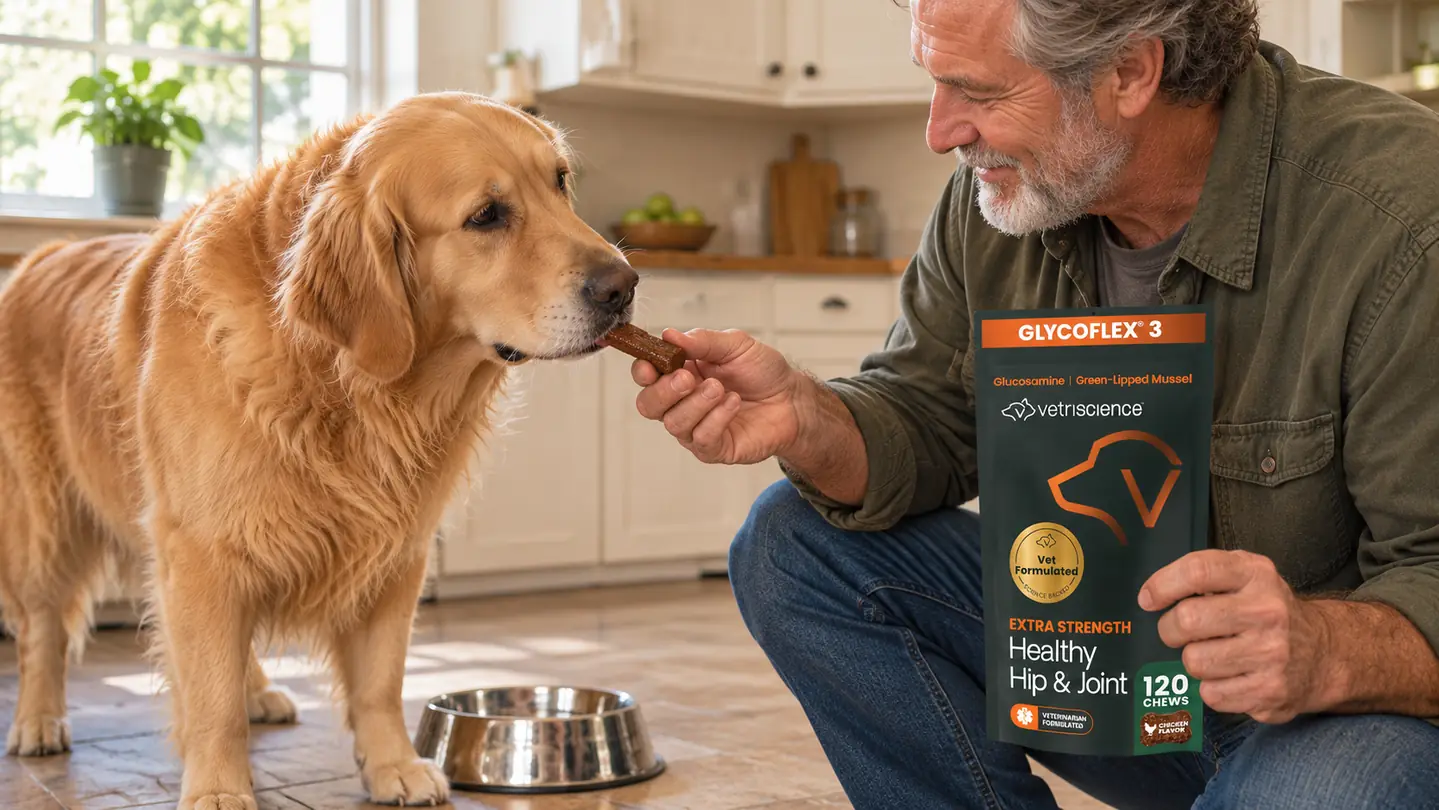
What Is Actually in the Bag
The bag is 120 bite-size chicken chews and weighs about two pounds, so it takes real cupboard space. The formula is the reason I chose it over the plain glucosamine tablets I had been looking at: 1,000 mg of glucosamine HCl and 1,000 mg of MSM per chew, plus green-lipped mussel and DMG. That is a fuller panel than most of what sits beside it on the shelf, and green-lipped mussel was the ingredient I had been reading about.
VETRISCIENCE describes the formula as vet-formulated and allergy friendly, and lists it for medium, large and giant breeds. I am not a nutritionist and I am not going to pretend to audit a label on your behalf. What I can tell you is that the numbers are printed clearly, the ingredient list is not hiding behind a proprietary blend, and our vet looked at the bag and did not flinch, which is the standard I actually use.
The chew is a delivery method, not a bonus. Tucker takes his without argument, which matters more than it sounds like it should, because a supplement a dog refuses is a supplement you have wasted money on. If your dog is fussy about texture, buy the smallest size you can and test one before you commit to a two pound bag.
I had been giving him a plain glucosamine tablet from the pet store for a few months before this, and the difference in compliance was the first thing I noticed. He ate the tablet under protest. He eats these like he does not know they are good for him. That does not prove anything about the formula. It does mean the chews actually get into the dog, which is step one.
What Nobody Tells You About the Timeline
Joint chews are not pain relief and they are not anti-inflammatories in the way a prescription drug is. They are nutrition aimed at a long-running problem. That means the honest timeline is measured in weeks to months, not days, and the first month is essentially a bet. Nobody puts that on the front of the bag, and I understand why, but it is the single most useful thing I can tell you.
The second thing nobody tells you is that you will not get a clean answer if you change everything at once. Weight, exercise, a new bed, a new food, a ramp by the stairs, all of it helps and all of it muddies the water. If you want to know whether the chews are doing anything, pick one thing to change at a time. I know that is slower than you want. It is also the only way to avoid guessing.
The third thing is consistency. A missed week here and there probably does not ruin anything, but this is a daily product and it works on accumulation. I put the bag next to the coffee maker for the first month so I could not walk past it without remembering. That is not a review of the product. It is a review of being fifty-eight and busy.
The other thing I would tell a friend is to write down the starting point. Not a fancy log. One sentence about how your dog gets up, how the stairs go, how the car goes. Four months from now you will not remember, and you will be tempted to credit the chews for a good week or blame them for a bad one. A note solves that.
The Parts That Annoyed Me
The routine. This is a daily product, and daily products ask something of you. The bag is 120 chews and about two pounds and it lives in your cupboard, and every morning you are doing a small piece of administration before you have had your coffee. That is not a flaw in the formula. It is a real cost, and it is the reason a lot of half-used bags end up at the back of a pantry.
The sizing. The listing puts this formula in front of medium, large and giant breeds. If you have a small dog, this is probably not the bag you want, and I would rather say that plainly than let you buy it and split chews in half. Splitting a chew is guesswork, and guesswork with a supplement is how you end up not knowing whether it worked.
The shellfish question. Green-lipped mussel is shellfish, and if your dog has ever had a reaction to shellfish, that is a conversation to have with your vet before the first chew, not after. Nobody in the review section mentioned it. It is not a reason to avoid the product. It is a reason to read the panel.
And the cost per chew sits above a bare glucosamine tablet. You are paying for the wider panel, and whether that is worth it depends on your dog and your budget.
The other option I considered was a chew with a single ingredient, straight glucosamine, which is cheaper per chew. I went with this one because the panel includes MSM and green-lipped mussel and because our vet had no objection. If your dog has a sensitive stomach, though, starting with one ingredient and adding from there is the more careful path, and I would not argue with anyone who took it.

What Actually Changed for Tucker
Around the fifth or sixth week I noticed he was getting up from his bed in one motion instead of two. That is the whole observation. No drama, no leap, just a dog who used to push himself up in stages and now did not. I wrote it on the fridge note and did not trust it for another two weeks.
Morning is where I notice it most, because morning is when a ten year old dog is stiffest. He used to need a minute after standing up before he would walk anywhere, a slow three or four steps while everything loosened. Now it is one or two. I know how that sounds. It is a small number of steps. It is also the difference between a dog who looks old and a dog who looks like himself.
The stairs are the honest test in our house, because the bedroom is upstairs and he insists on sleeping where we sleep. Before the chews he would stop on the landing, once, on the way up. In the last two months he has mostly stopped stopping. The Subaru is better too, though I also started lifting him rather than letting him launch, so I cannot give the chews full credit there and I will not.
The river trail is unchanged. He still sets the pace, and the pace is still slower than it was three years ago. That matters, because a supplement review that claims a full reversal is either a lie or a dog who was never that sore. What I would say is this: he is more comfortable in the small daily movements, he is not bouncing, and I renewed the bag without agonizing over it, which is the most honest endorsement I have.
Around week six he got up from his bed in one motion instead of two. That was the first thing I noticed, and it was not something I could talk myself out of.
What I Liked
- Glucosamine at 1,000 mg and MSM at 1,000 mg per chew, with green-lipped mussel and DMG on the panel
- A chicken chew a seventy pound dog takes without a fight
- Full ingredient list printed clearly, no proprietary blend
- Our vet looked at the panel and was comfortable with it
- A visible difference in how he rises and climbs stairs by around week six
Where It Falls Short
- Takes weeks before you can judge it, so the first month is a bet
- Aimed at medium, large and giant breeds, so small dogs need a different option
- Green-lipped mussel means shellfish, worth a vet conversation if that is a concern
- Costs more per chew than a plain glucosamine tablet
- 120 chews go faster than a two pound bag suggests
Who This Is For
This is for the owner of a medium, large or giant dog who has started to show it in the small movements. The slow rise, the pause on the stairs, the hesitation at the car. A dog who is still walking, still eating, still himself, just a little less spring in the first five minutes of the day. That is Tucker exactly, and this bag fits that dog well.
It also suits an owner who will actually keep the routine and give it two months before deciding. If you want a yes or no in a fortnight, you will be disappointed by this and by almost everything else in the category, and I would rather tell you that now.
If you are already doing the boring things, the weight and the walks and the softer landing, this is a sensible addition rather than a replacement. It is not a substitute for any of that, and our vet was clear that the chews work alongside those things, not instead of them.
Who Should Skip It
Skip it if your dog is small. The listing points at medium, large and giant breeds, and splitting chews to fit a ten pound dog is not a plan I would follow. Skip it if your dog has a shellfish allergy or you do not know, until you have asked your vet. Skip it if your dog is limping, yelping or has suddenly gone lame, because that is a vet appointment and not a supplement decision, and no chew on the market is going to fix it.
And skip it if the money is tight this month. That is not me being polite. This is a product you have to buy repeatedly for months before you know anything, and a bag you resent paying for is a bag you will stop giving. Better to wait until it is comfortable than to start, stop and decide it did not work.
One more: skip it if you are looking for something to give on the bad days only. This is not that product. It is a daily thing, and if your dog has bad days, those are vet days.
If your dog is at the bottom of the stairs deciding, start here
Read the full ingredient panel on the listing, confirm the amount for your dog's weight with your vet, and give it two months before you judge it.
Amazon Check Today's Price on Amazon →