
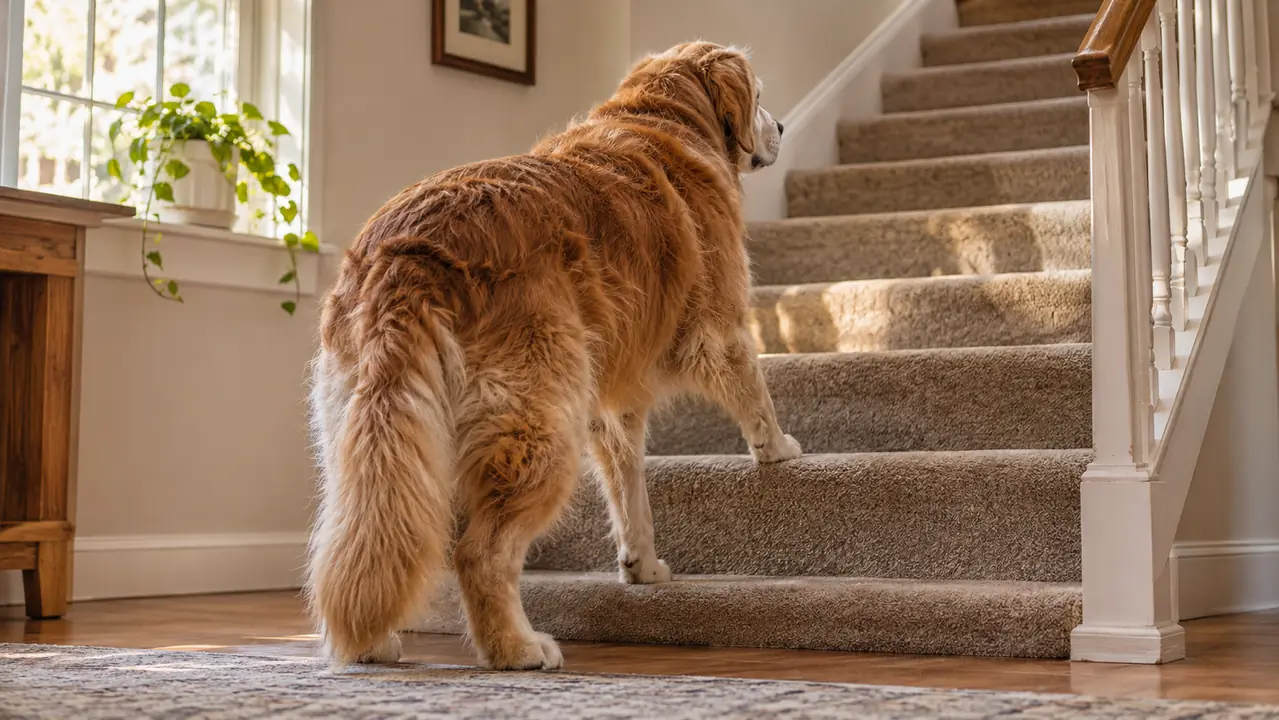
Tucker is ten years old, a Labrador mix, about seventy pounds, and for the better part of a year he has done this thing at the bottom of the stairs where he sets one front paw on the first step and then just waits. He is not hurt. He is not refusing. He is gathering himself, the same way I gather myself standing up out of a low chair now that I am fifty-eight. I put him on VETIQ Glucosamine Hip & Joint Chews last fall, a few weeks after our vet watched him walk the length of the exam room and used the word stiff three times in one sentence. What follows is what twenty-eight weeks of daily use actually looked like in our house, including the parts that were inconvenient.
I want to be plain about what this is. A soft chew is not a painkiller and it is not going to rebuild a joint. What it can do is give a stiff dog a steady supply of the things the cartilage in his hips and knees uses, and take some of the load off the inflammation side of the equation. Whether that shows up as a real change in your dog depends on the dog, the dose, and how much of the stiffness is arthritis versus something else entirely. That is why the first thing I did was ask our vet, and why the first thing you should do is the same.
The Quick Verdict
A soft chew he takes like a treat, with the amounts stated plainly on the label. It made a visible difference to how a stiff ten-year-old Labrador mix handles the stairs, and it is not a painkiller, not a cure, and not a substitute for your vet.
Amazon Check Today's Price →The bag that shortened the pause at the bottom of our stairs
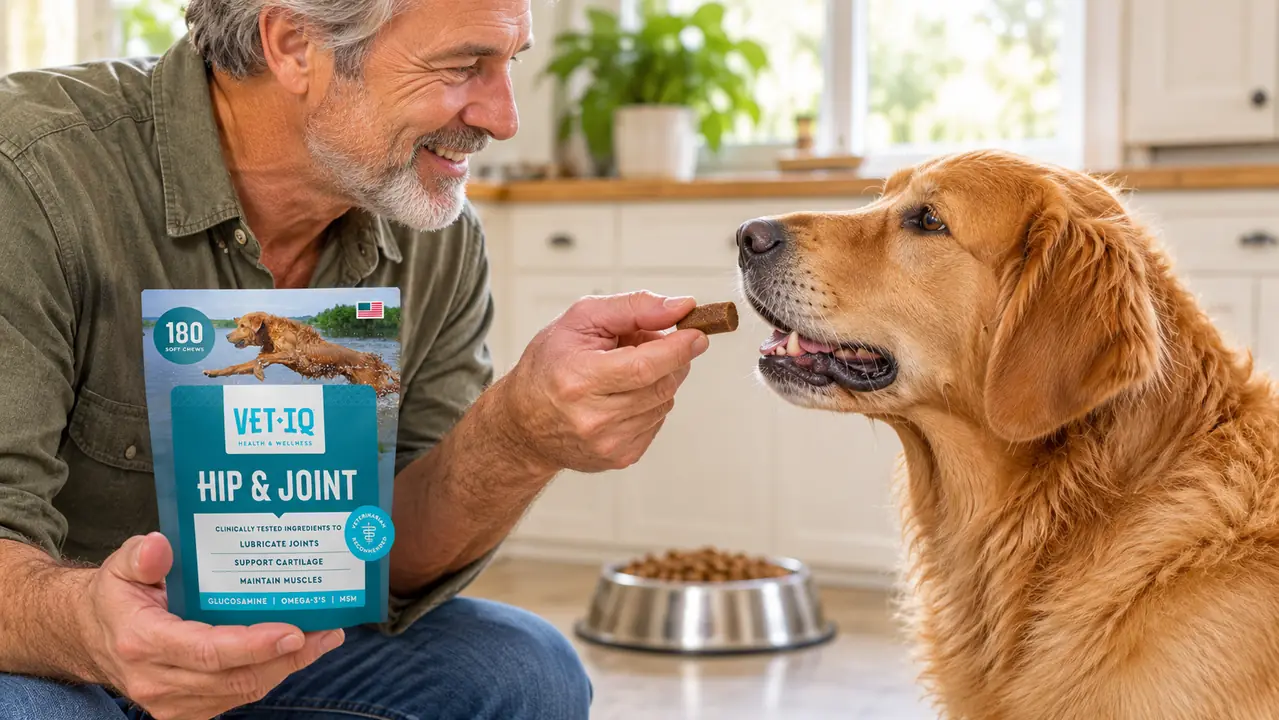
VETIQ Hip & Joint soft chews, chicken flavored, 180 count. The label lists 600 mg of glucosamine HCL alongside fish oil and krill, all in a chew most dogs will take straight from your hand. Six weeks is roughly how long it took here before I was sure.
Amazon Check Today's Price on Amazon →How I've Used It
Tucker gets his chews twice a day, morning and evening, in the amount our vet worked out for his weight. I did not guess at that. I brought the bag to a regular appointment, our vet read the label, we talked about what he was already taking, and we landed on a number. If your dog is on any other supplement, especially one with glucosamine in it, do that same thing, because doubling up is easy to do by accident and does nobody any good.
The bag lives in the pantry next to the kibble, and it is a big one: 180 soft chews, listed at 1.4 pounds and about 3 by 7.1 by 9 inches, so it takes up real shelf space. At two a day it lasts a good while, which is the main reason I stayed with it rather than switching around every few weeks. The chews are soft enough that Tucker takes them straight from my hand, and on the days he is being fussy I break one over his food and he eats it without noticing.
They are chicken flavored and they smell like it, which matters more than you would think. I have tried powders I had to hide in wet food and capsules I had to poke into peanut butter, and every one of those turned breakfast into a negotiation. Before this I spent three weeks with a tub of powder, measuring a scoop into his kibble and then watching him eat around the damp patches and leave the rest. I ended up making a warm broth topper just to get him to finish, which is more work at six in the morning than I am willing to commit to for the rest of a dog's life. A soft chew he will take like a treat is the difference between a supplement that gets used for eight months and one that sits half full in the cupboard until you throw it out.
What Is Actually in the Chew
The label lists glucosamine HCL at 600 mg, fish oil at 280 mg, and krill at 210 mg, with the glucosamine sourced from shellfish. The product title also names MSM. Glucosamine is the one most people have heard of, and it is the reason this category exists at all. Fish oil and krill are there for the omega-3 side of things, and the listing ties the formula to joint and bone health first, with skin and coat and digestive health noted as well.
I read a label the way I read a recipe now, which is to say slowly and out loud. What I liked here is that the main ingredients are stated in plain numbers rather than folded into a proprietary blend where you cannot tell how much of anything you are getting. What I did not find is any claim that it treats or cures anything, and I would have been suspicious if I had. The bag positions itself as support, and support is what it has been in our house.
One thing worth flagging if your dog has ever reacted to shellfish: the glucosamine here comes from shellfish, and the label says so. Ours has never had an issue, but I asked our vet about it specifically and you should too. I also compared this formula against the better known glucosamine brands before settling on it, and the honest summary is that the ingredients overlap heavily. The differences come down to how much is in each chew, whether krill is in the mix, and whether your dog will actually eat the thing. I kept a note on my phone for two weeks with the three labels side by side, the way I used to lay out a print job before I sent it to press, and the thing that decided it in the end was not the numbers. It was that Tucker would eat this one without me doing anything clever.
The Six Month Timeline, Honestly
Weeks one through three, nothing. I want to say that clearly, because the internet is full of stories where a dog is doing cartwheels by day four. Tucker ate the chews, enjoyed them, and moved exactly the same. Glucosamine is not that kind of thing. If someone tells you their dog was transformed inside a week, either the dog was not that stiff to begin with or something else in the routine changed at the same time.
Around week five I noticed the stairs. Not that he was faster, but that the pause at the bottom got shorter. Where he used to stand and consider the first step for a few seconds, he started stepping up almost immediately. That is a small thing to write down. It was not a small thing to watch. The morning I first saw it was a Tuesday in the second week of November, cold enough that the furnace had kicked on, and I remember standing at the bottom of the stairs with a laundry basket on my hip watching him go up without the pause. By week eight I was fairly sure it was real and not me wanting it to be real, because the pause came back on the two days I forgot the morning chew, then went away again once I got my act together.
The bigger test was the back of my Subaru Outback. Tucker stopped jumping in about a year ago and started waiting to be lifted, which is hard on my back and undignified for both of us. Somewhere in the third month he started putting his front paws up on the bumper again and looking back at me. He still needs a hand under him for the last part. But he is offering again, and a year ago he had quit offering. That, more than anything I could put on a chart, is why I bought the second bag.
I am not going to pretend I ran a controlled study. He lost a couple of pounds over the winter because I cut back his treats and walked him a little further. The weather warmed up. Any of that could be part of it. What I can tell you is that nothing else in his routine changed in the same direction at the same time, and the stair pause is the kind of detail I would have noticed either way.
By week eight I was fairly sure it was real and not me wanting it to be real, because the pause came back on the two days I forgot the morning chew.
The Parts I Don't Love
The bag is large and the chews are soft, which means the last third is where quality can slip if you are careless with it. I keep mine sealed and in a cool cupboard and I have not had a problem, but I would not leave it open on a counter for a month. If you have a small dog, a 180 count bag is a long commitment, and a smaller size might suit you better while you find out whether your dog will eat them at all. I decant roughly a week's worth into a small jar and keep the bag itself folded and clipped, which is a habit I picked up from a neighbor who does the same with her horse feed. It takes ten seconds a week and it means the chew at the bottom of the bag is as soft as the one at the top.
It is chicken flavored, and that is the only option in this listing. A dog with a poultry sensitivity is out of luck here, and so is a dog who simply does not care for chicken, which does happen. I would also say that at two chews a day this is a recurring cost rather than a one-time purchase, so it is worth looking at today's price for the 180 count and working out what a month actually runs you before you build a routine around it.
And it did not fix everything. After a long weekend walk on the river trail he is still stiff that evening, and he still takes his time getting up off the rug. A chew is not a substitute for keeping his weight down, which our vet reminds me about at every single visit, and it is not a substitute for the anti-inflammatory she prescribed for his bad days. It is one layer. It has been a useful layer, but it is one.
Where a Chew Stops and a Vet Starts
Stiffness in a ten-year-old Labrador mix is not automatically arthritis, and it is not automatically something a supplement can help. It can be a soft tissue problem, a spinal issue, or a dozen other things. Our vet did an exam and talked me through what she was feeling for, and that appointment is the reason I am comfortable writing any of this down. If your dog is limping, yelping, dragging a leg, or has stopped eating, put the bag down and make the call.
The other thing our vet said, and I have repeated it to two neighbors since, is that the bloodwork matters. Liver and kidney values, weight, and a real conversation about what else the dog is taking. Supplements are not tested the way drugs are, and the label is a starting point rather than a guarantee. That is not a reason to skip them. It is a reason not to treat a bag of chews as a diagnosis.
What I Liked
- Soft chicken flavored chew that most dogs take straight from the hand
- Glucosamine, fish oil and krill all stated in plain numbers on the label
- 180 count bag lasts months on a twice-a-day routine
- Visible difference in how our dog handled the stairs by week five
- No proprietary blend hiding the amounts
Where It Falls Short
- Chicken is the only flavor in this listing
- The last third of a large bag can dry out if you do not seal it well
- Four to six weeks before you know whether it is doing anything
- Not a replacement for prescribed pain management or weight control
Who This Is For
If you have a dog in that in-between stage, not lame, not fine, slower on the stairs and slower getting up off the floor, this is a reasonable first thing to try, especially once your vet has ruled out the obvious problems. It suits owners who want a chew their dog will actually eat, because the best formula in the world does nothing from inside a cupboard. It suits anyone who wants the amounts stated on the label rather than folded into a blend. And it suits people willing to give it six weeks before deciding, because six weeks is roughly what it took here before I trusted what I was seeing. It also suits the owner who has already heard the word arthritis in an exam room and came home with something for the bad days, and who wants a daily routine in between. That was our situation exactly, and the VETIQ chews and the prescription have sat side by side without a conflict.
Who Should Skip It
Skip it if your dog has a known shellfish or chicken sensitivity, if your vet has already put him on a prescription joint diet or a therapeutic dose of glucosamine, or if you are hoping for something that works this week. Skip it if your dog swallows soft chews whole without chewing, since that is a conversation for your vet rather than a review. And skip it if the only reason you are reading this is that someone online called it a cure. It is not that, and I would rather lose the click than have you find out the hard way.
Twenty-eight weeks, one big bag, and a dog who offers to jump again
VETIQ Hip & Joint soft chews in the 180 count bag, chicken flavored, with glucosamine, fish oil and krill stated on the label. Give it six weeks and watch the small things: the stairs, the tailgate, the way he gets off the rug. Those were the tells for us.
Amazon Check Today's Price on Amazon →