

Tucker started hesitating at the back of my Subaru Outback about a year ago. Not refusing to jump in. Just a pause first, a small gathering of himself before he committed, like he was doing the math. He is a 10-year-old Lab mix, about 70 pounds, and for nine years of his life he never once thought about a jump.
That pause is how it starts. Not a limp, not a yelp, not some dramatic morning where he cannot get off his bed. Just a dog who takes the stairs to the bedroom a little more carefully than he did last winter, and a person who notices and then spends three months wondering whether she is imagining it. When I finally asked our vet, she said the thing I have repeated to every friend since. The supplement is the easy part. Doing it in the right order is what makes it work. What follows is the order I wish someone had handed me, and it is the same order I now use with VETRISCIENCE Extra Strength Healthy Hip and Joint for Dogs.
One bag, one correct amount, one four-week log. That is the whole starting kit.
VETRISCIENCE Extra Strength Healthy Hip and Joint is a chicken chewable with 1000 mg of glucosamine HCl, 1000 mg of MSM and green-lipped mussel, in a 120 count bag of bite-size chews. Settle the amount with your vet, then start writing things down.
Amazon Check Today's Price on Amazon →Step 1: Get the diagnosis before you buy anything
It is tempting to skip this part. A chewable is not a prescription drug, it sits on a shelf next to the kibble, and the internet is full of people who swear their dog was different in a week. I felt that pull myself. I had a bag in a cart twice before I made the appointment.
Before the appointment I tried the free things first. I moved his bed out of the draft from the back door, I put a cheap runner rug at the bottom of the stairs so his back paws had something to push against instead of bare hardwood, and I cut the morning walk from thirty-five minutes to twenty-two because he was lagging right around the turnaround point. None of it was wasted. But none of it touched the pause at the car, and what it did do was show me which surfaces and which distances made him look worse, which turned out to be exactly what our vet wanted to hear about.
A stiff back end in a 10-year-old Lab is not one thing. It can be arthritis in the hips. It can be the knees. It can be the lower spine, or a soft tissue strain from a bad landing off the couch. What helps depends on which of those you are dealing with, and a dog with a sensitive gut or a bleeding disorder may need a different plan entirely. Our vet did a hands-on exam, watched Tucker walk and trot on the hard floor of the exam room, and moved each hip through its range while he stood there being politely confused. That took ten minutes and it cost less than the bag of chews I had almost bought.
Ask about interactions while you are there, and ask which ingredients your vet would rather avoid for your dog specifically. Write the answers down on paper or in your phone. You will not remember them in six weeks, and the second conversation is always easier when you can point at a note instead of trying to reconstruct it from memory.
Step 2: Pick one supplement, not three
The most common mistake I see in the dog groups I follow is stacking. Someone starts a glucosamine chew, adds a mussel powder, adds an oil, adds a turmeric paste, and then has no idea which one is doing anything. Worse, the dog is now getting three times the glucosamine and nobody is keeping track of the total.
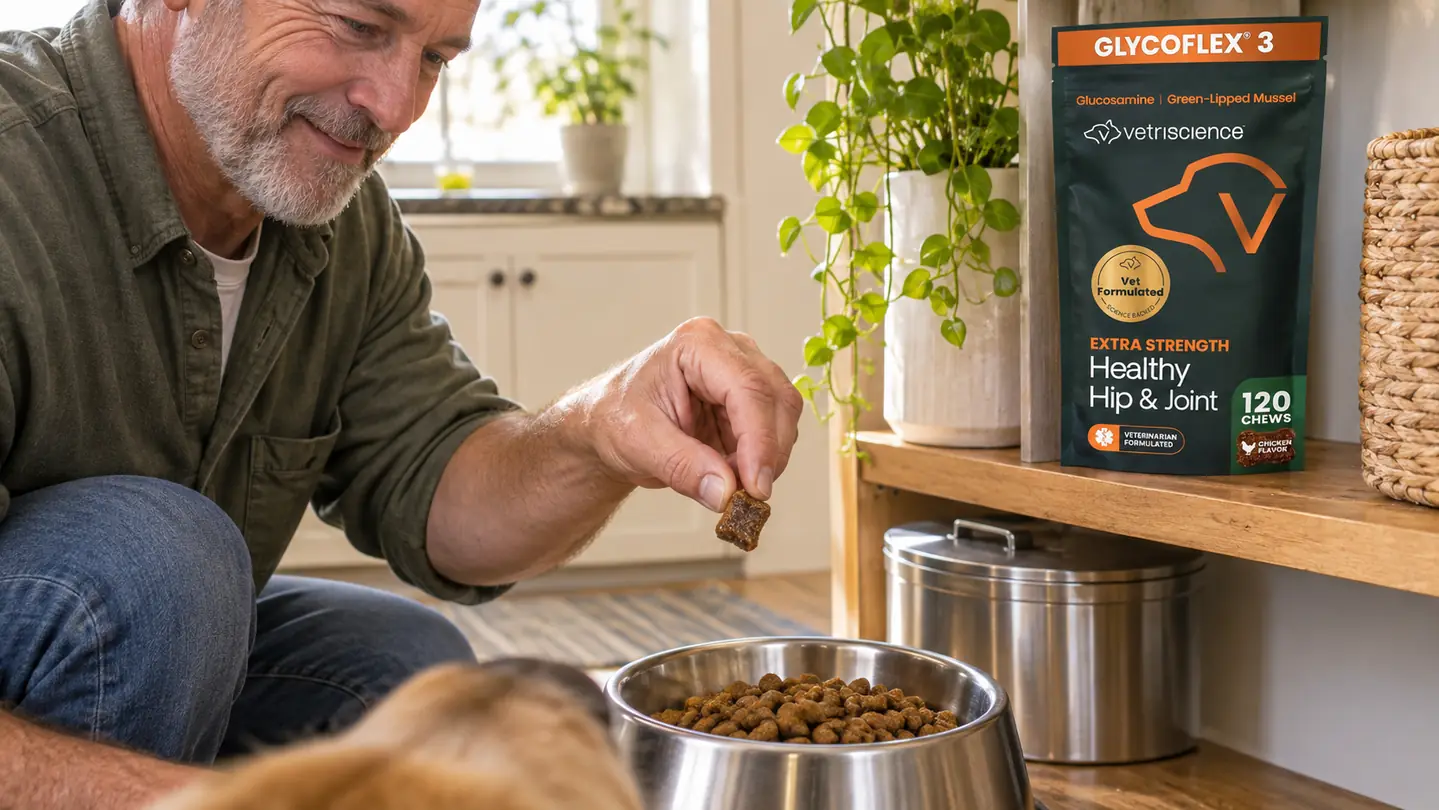
Start with one product and give it a fair run. I use VETRISCIENCE Extra Strength Healthy Hip and Joint, a chicken chewable built around 1000 mg of glucosamine HCl, 1000 mg of MSM, and Perna canaliculus, which is the green-lipped mussel, plus DMG. The listing describes it as allergy friendly, and that mattered to me because Tucker has a sensitive stomach and I did not want to spend three weeks guessing whether a reaction was the supplement or the base it came in. It is formulated for medium, large and giant breeds, which fits a 70-pound dog better than the tiny chews sold for a 12-pound terrier. As of this writing it carries 9,125 ratings at 4.6 stars, and while that proves nothing about your dog, it does tell you the bag is not some fly-by-night formula that will vanish in a month.
The bag itself is bigger than I expected, fourteen by six and three-quarter inches and about two pounds, with 120 bite-size chews inside. In my house that bag lives on the shelf directly above the kibble bin, and that placement matters more than it sounds. A bag that lives in a cupboard behind the good china is a bag you will forget twice a week. Keep it where you keep the food and half the routine takes care of itself.
Read the label with your vet and settle the amount before the first chew goes anywhere near the bowl. Do not eyeball it. Do not split a chew to stretch the bag without asking first. Do not double up because you missed a morning. A steady correct amount is the entire point, and the 120 count bag is easy to ration once you know what the daily number actually is.
Step 3: Introduce it slowly and change nothing else that week
For the first two weeks I changed exactly one thing, which was the chew. Same food, same morning walk around the neighborhood, same bedtime. If you start a supplement and a new food in the same week and the stool goes soft, you have learned nothing and you have two suspects.
Watch the stool. Watch for itching around the ears and between the toes. Watch for vomiting or a sudden loss of interest in dinner. Most dogs do fine, but a chewable with mussel and MSM is not nothing, and a dog's gut can take a few days to agree with it. If something looks off, stop and call your vet rather than pushing through because you already spent the money.
There is one day from that stretch I still remember. The second Sunday, we did the river trail and he stopped at the bench about halfway instead of at the end, which he had been doing for a month. I was ready to blame the chew and quit. Instead I read back the note I had made the week before and saw he had done exactly the same thing the week before I started, on a colder morning with a hard wind coming off the water. The chew was not the cause. The weather was. That is the kind of false alarm a slow two-week introduction and a short note will save you from.
Tucker took his first one as a treat, which surprised me, because he is the type who inspects anything new for a full ten seconds before committing. That is a small detail but worth knowing. A dog who turns his nose up at a chew is going to make the next six months very long, so if it happens, ask about switching forms rather than fighting it every morning.
I did not need Tucker to be a puppy again. I needed to know whether the pause at the back of the car was getting shorter. So I wrote it down.

Step 4: Score the small things once a week
You cannot measure a supplement by how your dog looks on a Tuesday. You measure it by the things you would otherwise forget by Thursday. I opened a note in my phone with five lines and I scored each one from 1 to 5 every Sunday evening, which takes about ninety seconds and is the most useful thing I have done in this whole process.
Before the scoring I tried just remembering. I would think, he seems a bit better, and then three days later I would think, he seems worse, and I had no way of telling whether anything had actually moved or whether I was simply in a different mood that afternoon. The note fixed that. I also started dating every entry, because a Sunday score with no date attached is just a feeling with a number on top of it.
The five lines were these. How long the pause is before he jumps into the Outback. How the stairs to the bedroom look at bedtime. How long it takes him to rise after a long nap on the living room rug. Whether he finishes the morning walk at the same pace he started it. And whether he still brings me a toy in the evening without being asked.
Four weeks in, my honest answer was that two of those five had moved and three had not. That is a normal result and it is exactly why the log matters. Without it I would have said he seems about the same, and I would have quit something that was quietly doing a little good in the background.
Step 5: Re-check at 8 to 12 weeks, then settle in
Joint supplements are not painkillers and nobody should expect a different dog on day three. Our vet's advice was to give it a full eight to twelve weeks at the right amount before judging it, and to keep the rest of the routine steady across that stretch so the answer means something. That is a long time to be patient, but it is shorter than the year I spent speculating.
At the twelve-week mark I brought the notes to the appointment. We went through them together and that conversation was worth more than every forum thread I had read combined. We kept the chew at the same amount and added one thing, which was a shorter route on the days after a long river trail walk. That was a change to the routine, not to the supplement, and it helped more than I expected.
If your dog shows nothing after twelve honest weeks at the correct amount, that is information too. Stop, and put the money toward whatever your vet thinks has better evidence for your dog's specific diagnosis. A supplement is not a loyalty test and there is no prize for finishing the bag.
What Else Helps
Weight is the biggest lever and it is not close. Every extra pound on a 70-pound dog with sore hips is a pound carried up the stairs twice a day. Our vet put Tucker on a modest reduction and the difference in how he moved was bigger than anything the chews did on their own. If your Lab is carrying a couple of pounds, deal with that first and treat the supplement as support rather than the main event.
Surfaces matter more than people realize. I put a runner rug down the hallway where he used to slide on the hardwood, and I stopped letting him launch off the couch like a much younger dog. Shorter, more frequent walks beat one long weekend hike, and the river trail is easier on him than the concrete sidewalk around the block. Keep the nails trimmed so his paws can grip properly, and if he is struggling with the car, a ramp or a folding step takes the jump out of the equation entirely.
And keep the vet in the loop about the bigger tools. There are prescription options for arthritis pain and inflammation that do things a chew cannot, and a supplement is an addition to that plan, not a replacement for it. Nobody should be managing real pain with over-the-counter chews alone because they are hoping to avoid a conversation.
The bag that made the twelve-week log worth keeping.
120 chicken chews with 1000 mg of glucosamine HCl, 1000 mg of MSM and green-lipped mussel. Set the amount with your vet, start the note in your phone, and give it a full eight to twelve weeks before you decide anything.
Amazon Check Today's Price on Amazon →