
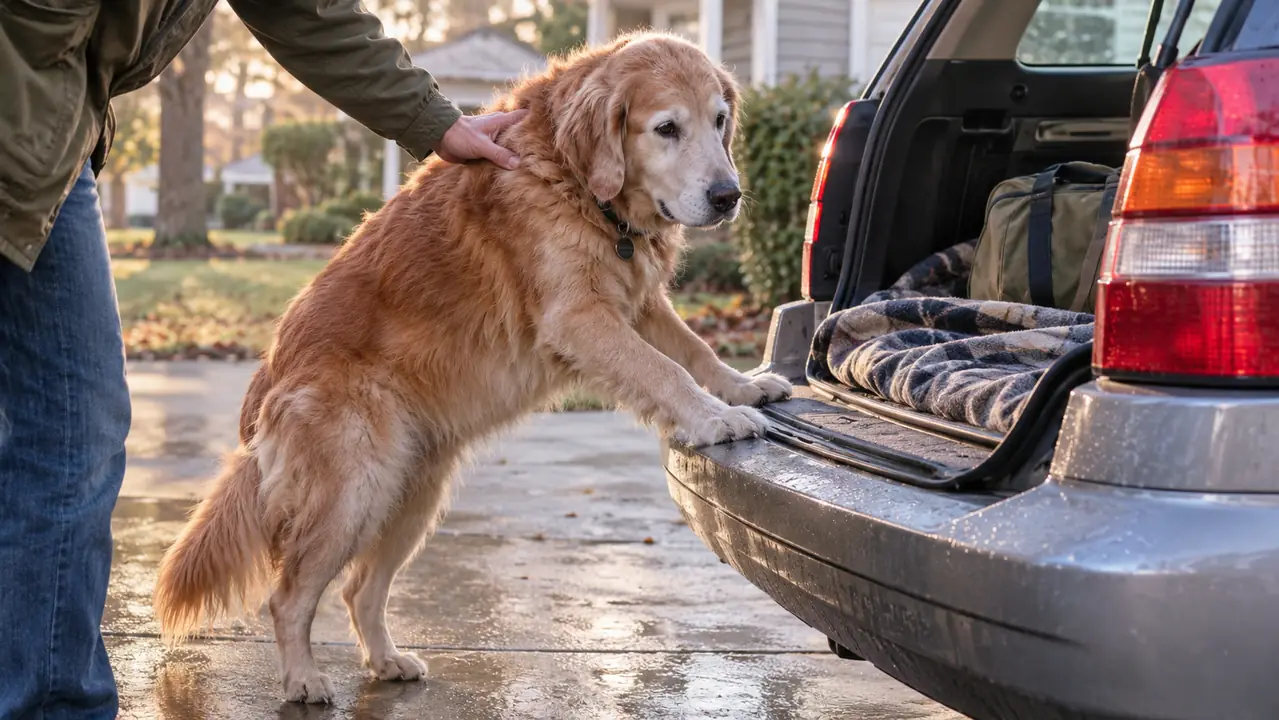
The sound Tucker makes when he thinks about getting in the car is not a whine. It is a stall. He walks up to the open tailgate of my Outback, puts his front paws on the bumper, and then stands there with his back legs still on the driveway, waiting for a second opinion. About a year ago that stall turned into a full stop, and I started lifting his back end into the cargo area. He is seventy pounds. I am fifty-eight. That math does not work for long.
What I understand now is that the car was never the problem. It was the place where the problem showed itself. A dog who hesitates at a tailgate is usually telling you something about his hips, his knees, or the general stiffness that settles in overnight and takes twenty minutes to walk off in the morning. This is the order I would do it all again in: vet first, gear second, daily support third. The daily support in our house is VETIQ hip and joint chews, and they do their quiet work in the background while the rest of the plan handles the rest.
Start the daily part now. The ramp will still be there next week.
VETIQ Hip and Joint soft chews are the piece of Tucker's routine that happens whether or not we get in the car that day. Chicken flavor, soft chew, and a job the label explains better than I can. Ask your vet for the right amount for your dog's weight before you open the bag.
Amazon Check Today's Price on Amazon →Step 1: Get the Vet's Read Before You Buy a Single Chew
The first thing I did wrong was shop. I had three different joint supplements sitting in a cart before I had any idea what was actually bothering my dog. Our vet put a stop to that in about ten minutes. She watched him walk into the exam room, ran her hands down his spine and over both hips, and lifted each back leg in a slow arc. Then she asked a question that reframed the whole thing: does he stall in the morning, after a nap, or all day long?
Morning and after naps, I told her. She nodded. That is the stiffness that warms out of a dog as he moves, and it is worth managing, but it is a different animal from a dog who cannot rise at all. She ordered x-rays, not because she was certain of anything, but because a ten-year-old Labrador mix has a long list of things that can look like arthritis and are not: a soft tissue strain from one bad landing off a tailgate, a knee issue, even a nail problem that changes how he shifts his weight. Ruling those out first meant whatever I did next had a real target instead of a guess.
She also weighed him, which turned out to be the least expensive thing that helped. Tucker was four pounds over where she wanted him. Four pounds on a seventy-pound dog with sore hips is roughly like me carrying a bag of groceries up and down the stairs every time he uses the stairs. That number is now written on the fridge in dry-erase marker. If you take one thing from this article, take the scale.
Step 2: Give Him Something to Walk Up, and Practise It Before You Need It
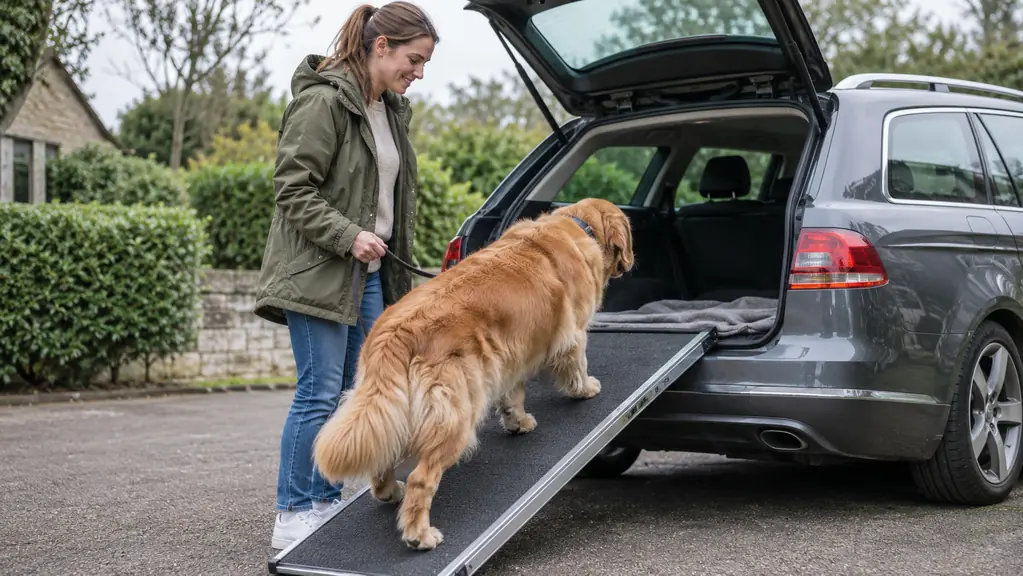
I bought a folding ramp for the Outback because lifting him was wrecking my back and making him flinch when my hands went under his belly. The first version was too steep and too narrow and he wanted nothing to do with it. The second one is wider, has a surface his nails can grip, and I back the car out of the garage onto the flat driveway so the base of the ramp sits level instead of on a slope.
The ramp itself was never the hard part. The hard part was teaching him that it was his idea. I laid it flat on the driveway first, on the ground, and just put a treat at one end and let him walk over it for three days. Then I raised one end onto a low porch step. Then the tailgate. No pushing, no lifting, no coaxing in a baby voice, because all three of those tell a worried dog that this thing really is worth worrying about. It took about a week and a half of five-minute sessions, and the sessions where he walked away first were the ones that moved us fastest.
If you skip the ramp entirely, a sturdy step stool works for a lower car. What does not work is the halfway lift, where you get the front end in and then boost the back. I did that for months. It hurts you, it teaches the dog that the car is a thing that happens to him, and it does nothing about the joint that was the reason for the whole struggle.
Step 3: Warm Him Up Before the Jump, Not After
Our vet explained the warm-up in a way that stuck with me. Joints and the fluid around them behave better when they have been moving for a few minutes. A dog who has been sleeping on the bedroom floor for eight hours and then goes straight from the door to the tailgate is asking a cold joint to do the hardest thing it will do all day. That is why the morning stall is worse than the afternoon one.
So now the car never comes first. Before we leave, Tucker gets a slow five-minute walk around the block, nose down, no destination. It is not exercise, it is a warm-up. In Minnesota in January, I stretch that to eight minutes and I am not embarrassed about it. On the coldest mornings he wears a coat, which he tolerates and I pretend he does not mind. By the time we reach the driveway, the hitch in his right hind leg has usually smoothed out.
The same logic applies at the other end. When we get where we are going, I let him stand and sniff for a minute before he lies down on his bed. Twenty minutes of lying still in a cold car is exactly what sets him up to be stiff when he stands up again.
Step 4: Put a Hip and Joint Chew Into the Same Five Minutes Every Day
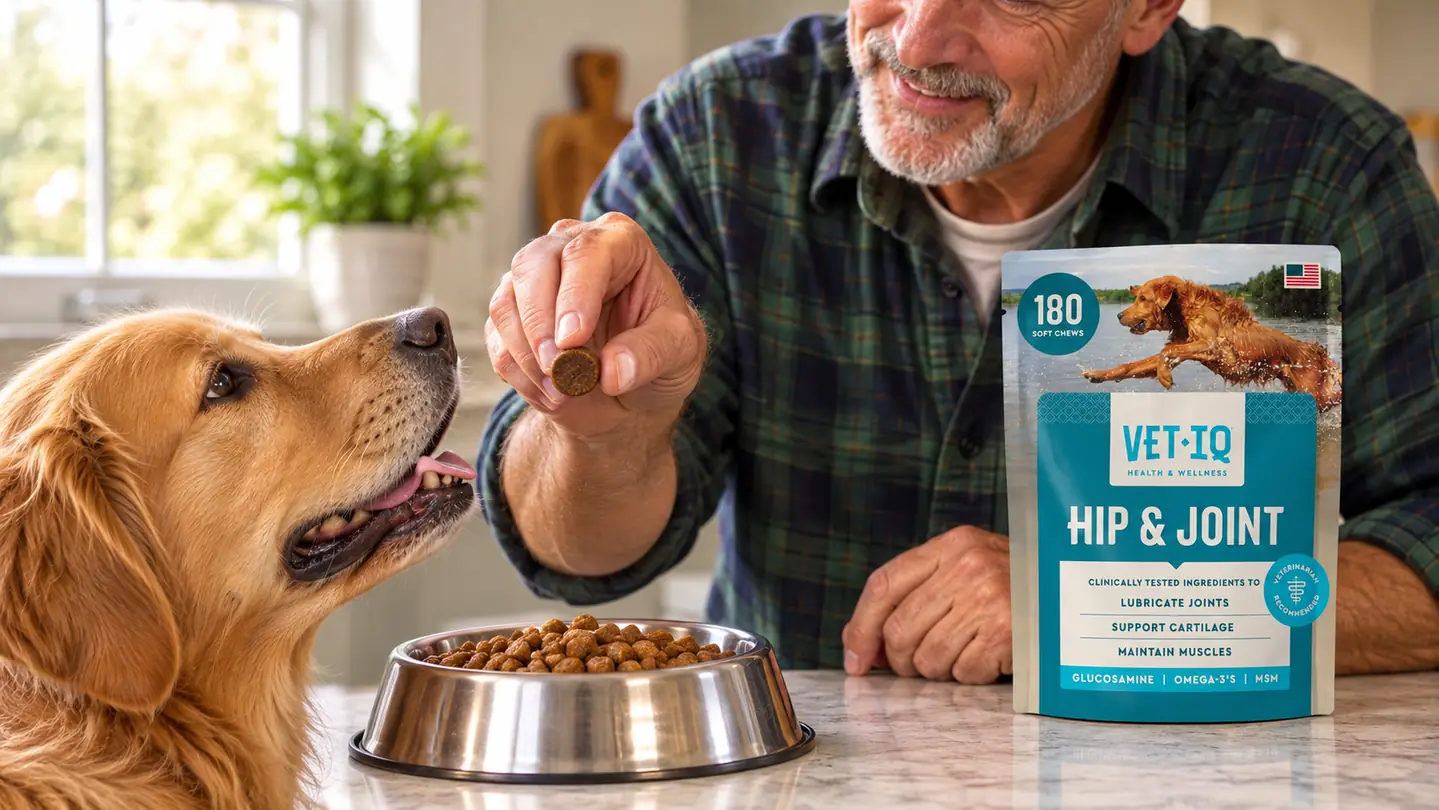
This is where VETIQ came into the routine, and I want to be careful about what I claim for it, because I have read enough of these articles to be tired of them. A soft chew is not a painkiller. It did not make my dog young again. What it did was give me one small, repeatable thing I could do every single morning that was actually aimed at the joint rather than at the symptom.
The formula is on the label and worth reading before you buy: glucosamine HCL at 600 mg, fish oil at 280 mg, and krill at 210 mg, in a chicken-flavored soft chew. The bag we keep on the counter is the 180 count, which is the size that stopped me from feeling like I was reordering every other week. Tucker takes his after the warm-up walk, on the same tile in the same kitchen, and he now sits by the counter before I have my shoes off. That is not a health outcome. It is just a dog who likes a chicken chew.
The amount matters more than anything I can tell you here, and it is the one question I would not answer for another person's dog. Ask your vet how much, given your dog's weight and whatever else is going on. If your dog is already on a joint supplement, or on any medication at all, bring the label to the appointment rather than stacking a second product on top and hoping. Our vet read the ingredients off my phone in the exam room and told me what she thought. That conversation cost me nothing.
As for timing, be patient enough to be honest about it. At two weeks I could not tell you anything. At about a month I noticed he was getting up from his bed in one motion instead of two, though that could have been the ramp, the warm-up, the four pounds, or all of it together. Four months in, the stall at the tailgate lasts a couple of seconds instead of eight or nine. On the first genuinely cold morning of the season, he still hesitates. I do not read that as failure. I read it as an old dog in Minnesota.
Step 5: Change the Car, Not Just the Dog
The last piece is the easiest one to overlook, because we spend all our attention on the dog. The car can be made friendlier. I park where the ground is flat instead of on the crowned part of the street. I keep a rubber-backed mat in the cargo area so his feet do not slide when he lands, which is the moment a lot of dogs tweak something. A blanket over the mat gives him something to grip and something familiar to stand on.
Getting out deserves more thought than getting in, and almost nobody thinks about it. A dog who has been lying down for half an hour is cold and stiff and then asked to hop down onto concrete. We use the ramp in both directions now. It adds about fifteen seconds to every trip and it removed the single worst moment of our week.
If you have a smaller dog, you can skip the ramp and simply lift with one arm under the chest and one under the hindquarters, close to your body, with your knees bent. If you have a dog Tucker's size and a bad back of your own, the ramp is not a luxury. It is the thing that lets you keep taking him to the river trail on Saturday, which is the entire point of all of this.
What Else Helps
A few small things that made a difference in our house, none of them expensive. Nails trimmed every four to six weeks, because a long nail changes the angle of the whole foot and pushes the load back up the leg. A couple of runners on the hardwood between the kitchen and the stairs, because a slipping dog braces hard and a bracing dog is a sore dog the next day. And his bed moved off the cold floor and out of the draft from the back door.
Walking changed too, and this was harder for me than for him. We do shorter, more frequent walks instead of one long one, and on the river trail we take the flat stretch along the water instead of the section with the hill. He is not less happy. He is arguably more happy, because a walk that ends before he is sore is a walk he wants to take again tomorrow. Your vet can tell you what your dog's limits look like better than any article, mine included.
And keep going back. We are on twice a year for checkups, and I now ask a direct question at each one: is he still comfortable, or are we at the point where we should talk about more than a chew and a ramp? That question is not giving up. It is the same reason I put the ramp in the driveway and the number on the fridge. If the day comes when glucosamine and a warm-up walk are not enough, I want to hear it from our vet while there is still something to do about it.
Four months in, the stall at the tailgate lasts a couple of seconds instead of eight or nine. On the first cold morning of the season, he still hesitates. That is not failure. That is an old dog in Minnesota.
The tailgate gets easier one morning at a time
VETIQ Hip and Joint soft chews are one part of a plan that also includes your vet, a ramp, and a five-minute warm-up walk. Start with the vet. Then see what a daily chew does over a couple of months.
Amazon Check Today's Price on Amazon →