
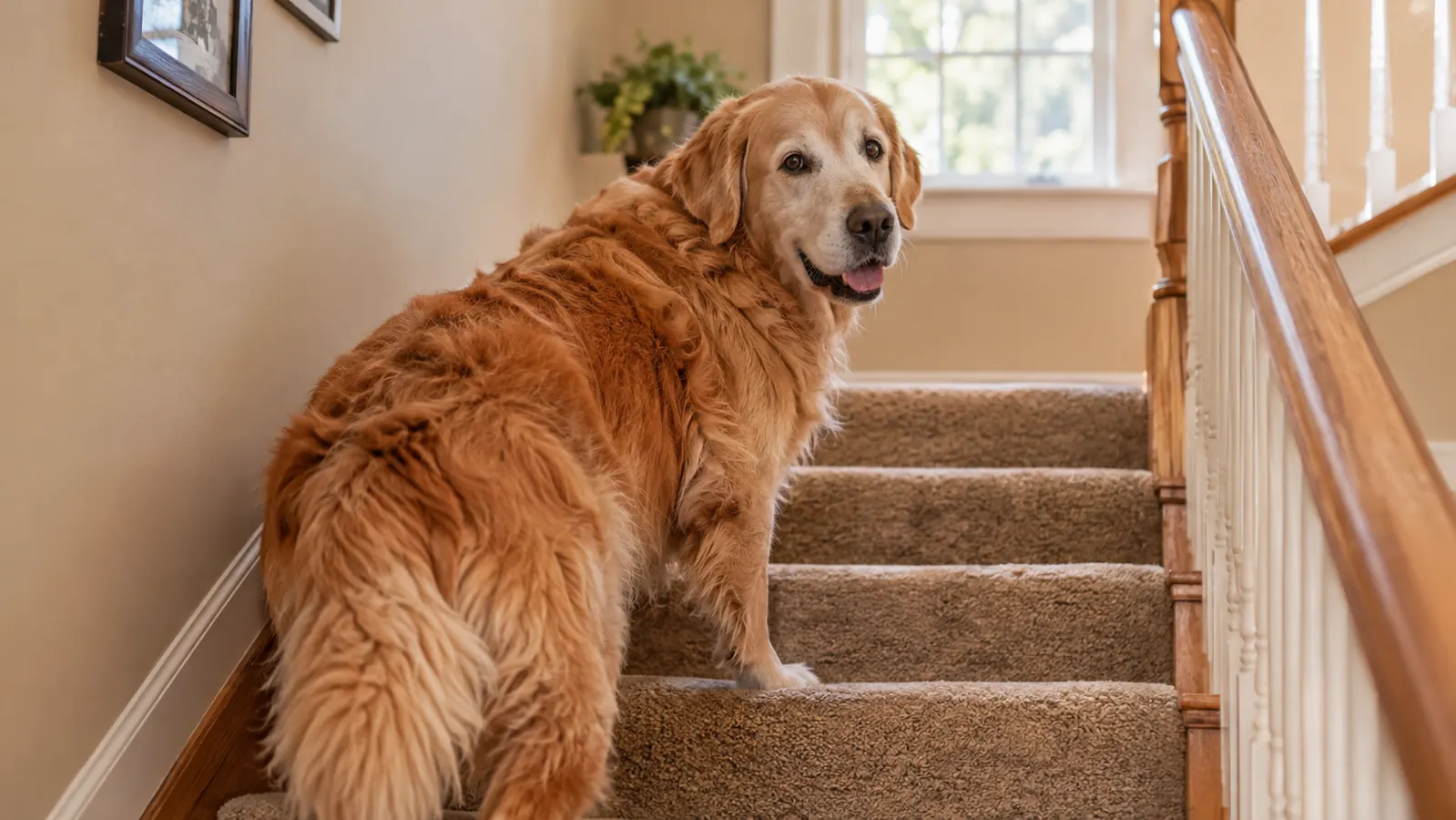
Tucker is ten, a Labrador mix who runs about seventy pounds, and for most of his life he took the stairs to our bedroom like a dog who had never considered that stairs could be a problem. Then last winter he started stopping halfway up. Not sitting, not whining, not making a sound. Just a pause on the landing with his back legs gathered underneath him. Twelve steps from the front hall to the bedroom door, and he stopped on the sixth one every night.
I did what most people do before they buy anything. I put a second bed in the living room so he would not have to come up at all, which he ignored. Then a friend from my old design studio mentioned she had her older dog on a mussel chew, and the one I ended up bringing home was Zesty Paws Mussel Mobility Bites. That is where this story starts, but it is not the whole of it, because a chew by itself would not have fixed our stairs.
The chew that earned a spot next to Tucker's bowl
Zesty Paws Mussel Mobility Bites are soft chews built around cold processed New Zealand green-lipped mussel, with natural glucosamine and chondroitin plus omega-3 fatty acids. Chicken and mussel flavor, ninety chews to a container. Tucker gets his before the morning walk and does not argue about it.
Amazon Check Availability on Amazon →Why the Stairs Give Out Before the Walks Do
A flat walk across the neighborhood is one motion repeated. Stairs are a different job. Going up asks the back end to push the whole body weight upward, one leg at a time, with no momentum to borrow. Coming down asks for control, which is harder than power on a stiff joint. That is why so many owners notice the stairs first, sometimes months before they notice anything on the river trail. The dog is not being stubborn. He is doing arithmetic, and the math on the sixth step has gotten worse.
The other thing I learned is that dogs are quiet about this for a long time. Tucker never yelped, never limped in a way I could point to, never refused a walk. He simply got more careful. If I had waited for him to cry out, I would still be waiting. That is the reason this article has five steps and not one. The chew is step four. Skip the first three and you will not know what is working, and neither will your vet.
Step 1: Have Your Vet Look at the Stairs, Not Just the Dog
I called our vet's office the week the nightly pause became a pattern. The exam was not dramatic. Our vet watched Tucker walk across the room, watched him turn, felt along his hips and his back, and asked me a string of ordinary questions. When did it start. Is he worse in the morning or at night. Does he hesitate on the stairs, on the furniture, in the car. I answered that he had also been slow about jumping into the back of my Subaru Outback for about a year, and she nodded as if that fit with something.
What I appreciated was the framing. She did not hand me a bottle and send me home. She talked about what we were managing, told me what to watch for if things changed, and asked what he was already taking. A green-lipped mussel chew is a support product. It is not a treatment and it is not a diagnosis, and no chew on a shelf can tell you whether your dog's problem is a joint, a ligament, or something else entirely. Get the appointment first. It is the cheapest step in this whole list and the one most people skip.
I also asked directly whether it was fine to add a mussel chew on top of what Tucker already gets. Our vet said it was reasonable, and asked me to keep a simple record of what he was taking and when we started, so that if anything changed we would have something to look at besides my memory. I wrote the start date on the lid of the container in marker, which is not elegant and worked better than any note on my phone.
Step 2: Change the Stairs Themselves
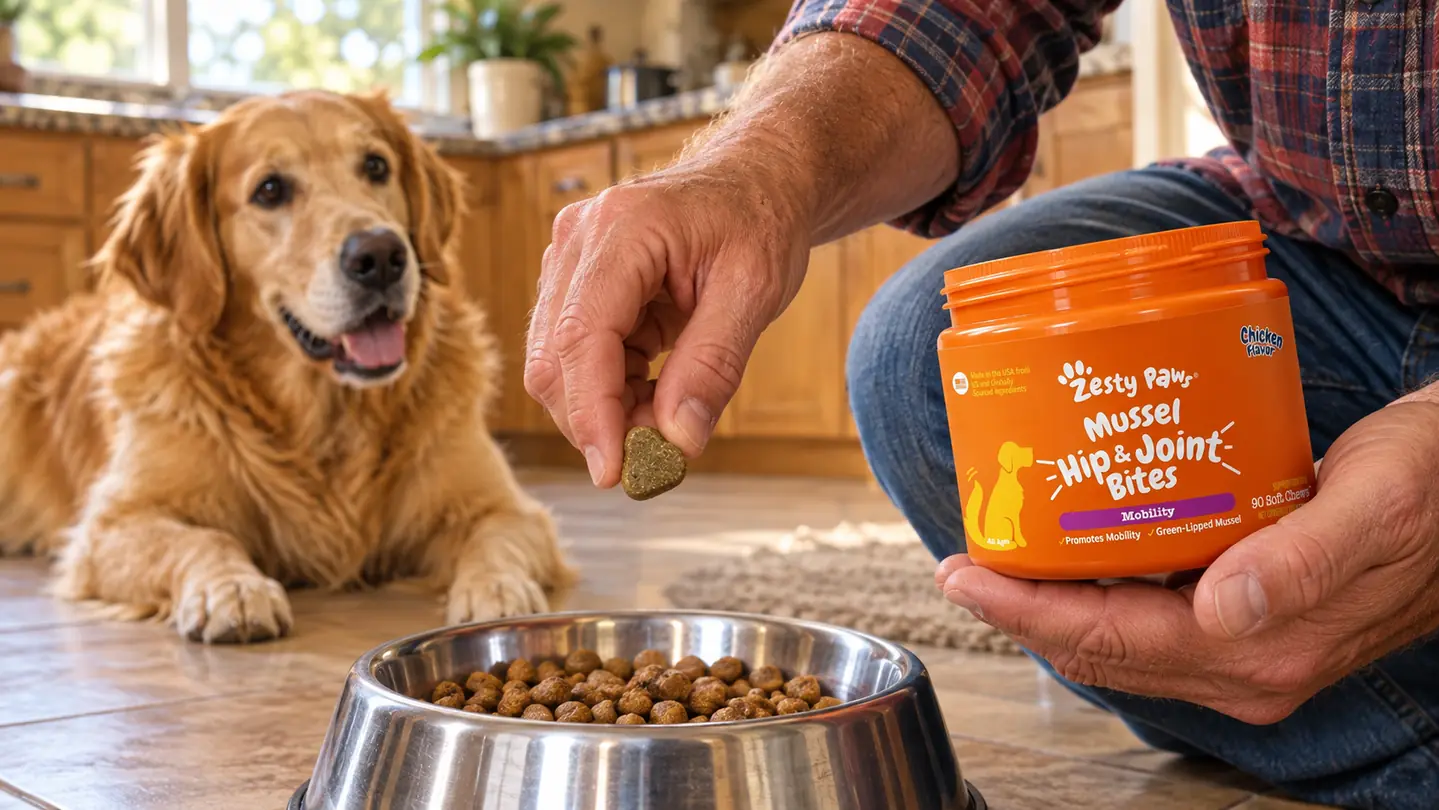
Our stairs are original to the house, which in St. Paul means wood treads and a lot of them. Slick wood under a dog's pads is a poor surface for a stiff back end, and I had never thought about it once in twenty years of living here. I bought a carpet runner with a rubber back and fixed it to the treads. It took an afternoon and a staple gun. The difference in how Tucker climbed was noticeable in the first week, mostly because the small slip at the top of each step stopped happening.
Two other fixes cost almost nothing. I put a night light at the top of the stairs, because a ten-year-old dog's eyes are not what they were and I had been asking him to climb in the dark. And I started keeping his nails shorter, on the groomer's schedule rather than my own vague one. Nails that click on hardwood are nails that are not gripping anything. If I had to rank these three by effort against payoff, the runner is the one I would do again tomorrow.
The last piece of step two was me. I stopped letting him barrel up behind me at his own speed while I carried laundry. Instead I go first, slowly, and let him set the pace behind me so he is never rushed and never crowded. It sounds fussy written down. In practice it is just walking up the stairs at a normal pace instead of a hurried one, and it removed the moment where he used to scramble to keep up.
Step 3: Warm Up Before the Climb
The morning descent was the worst part of our day, and it took me a while to see why. Tucker sleeps in our room. He wakes up stiff, and the first thing he has to do is navigate twelve steps before he has moved any other way. So I changed the order. He goes out the back door into the yard first, has a slow sniff around, and we do the stairs a few minutes later when he has already loosened up. Small change, real difference.
I added a short warm-up before the evening climb too. Not a workout. Two or three slow sit-to-stands on the carpet in the living room, a walk down the block and back, and that is it. Our vet was the one who suggested using the couch and the rug rather than anything that looks like equipment, and Tucker treats the whole thing as a slightly odd party trick that earns him attention.
What I would tell you about this step is that consistency matters more than volume. Ten minutes twice a day, every day, beat the longer weekend sessions I tried at first and then abandoned because they wore him out. A dog with a stiff back end does better with short and frequent than long and occasional, the same way I do at fifty-eight.
Step 4: Put the Mussel Chew on a Boring Schedule
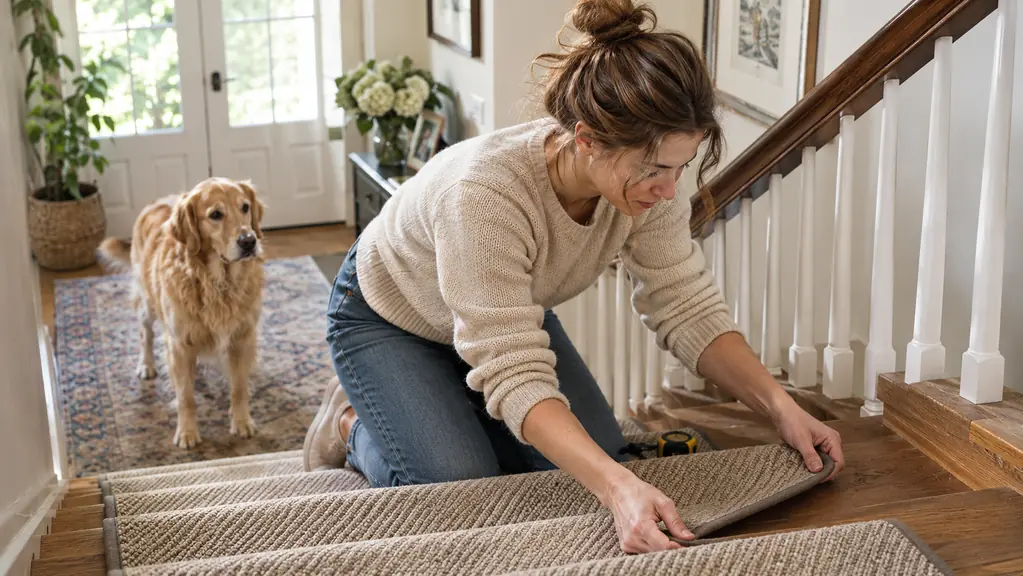
This is the part people want to read first, so I will be plain about it. Zesty Paws Mussel Mobility Bites are soft chews, chicken and mussel flavored, built around cold processed New Zealand green-lipped mussel with natural glucosamine and chondroitin and omega-3 fatty acids. The container holds ninety chews and the package lists the product weight at 7.9 ounces, so it is a small tub you can keep on the counter without it taking over the counter. Chamomile is on the ingredient list, which I noticed because I drink it.
The serving is on the label, based on your dog's weight, and I follow the label rather than a number I invented or heard somewhere. Tucker is at the heavier end at seventy pounds, so he gets what the chart says for his weight and no more. More is not better with this kind of product. I put it in the same spot on the same counter and hand it over at the same time every morning, because the schedule is the part I can actually control and the part that makes the fourth week comparable to the first.
Two honest notes. He likes the taste, but he is a Labrador and would eat a paper towel, so do not take his enthusiasm as a review. And I gave it four to six weeks before I formed an opinion, because that is the window our vet suggested and because a week tells you nothing except that your dog enjoyed a chew. The change I noticed was not dramatic. It was that the pause on the sixth step stopped happening, and then I stopped noticing it, which is its own kind of good news.
Step 5: Keep a Record So You Are Not Remembering It Wrong
I keep a short video on my phone, filmed once a week, of Tucker climbing the same twelve steps at the same time of night. Thirty seconds, no commentary, same angle. It sounds excessive until you try to remember whether your dog was better in March than in February. I could not do it. The video can, and so can the three-line note I keep in the back of a notebook: date, time of day, and which step he paused on.
The number on the step is the useful part. A dog who pauses on the sixth step is telling you something different from a dog who pauses on the tenth, and a dog who pauses going up is telling you something different from a dog who hesitates coming down. I logged those two things and nothing else. After a couple of months I had a page that our vet could actually read, which is worth more than my general impression that he seemed better lately.
And know when to stop reading articles and make a call. If your dog yelps, if he refuses the stairs entirely, if he starts carrying a leg, if he goes off his food, or if the trend on your notebook page is going the wrong way for two or three weeks, that is a vet conversation and not a supplement question. I would rather make that call and be told it is nothing than spend a month hoping a chew will handle it.
The change was not dramatic. It was that the pause on the sixth step stopped happening, and then I stopped noticing it, which is its own kind of good news.
What Else Helps
Weight is the lever nobody wants to talk about. Our vet said a few extra pounds on a dog with stiff hips is a few extra pounds going up every single step, every single day, and that trimming a little is one of the few things that reliably makes a difference. Tucker was not overweight, but he was close enough that we cut back a little on the between-meal extras and he is leaner now than he was last winter. He does not know he is on a diet. He thinks the portions are simply what they are.
A good bed on each floor has also earned its place. He has one upstairs next to our bed and one in the living room, so he is never choosing between lying down and coming to be near me. We have a folding ramp for the back of the Subaru Outback now, and it lives in the trunk. It looks like a lot of hardware for a seventy-pound dog, and it means he gets in without that gather-and-jump he had been doing, and I get to stop wincing at the curb.
The last one is route planning, and it is free. The river trail near us is flat and shaded and he does well on it. The hilly streets behind the house are not where we go on a bad day anymore. Shorter walks taken more often have replaced the single long one, and honestly he seems more interested in the neighborhood now than he did when we were covering more ground. Fewer miles, more sniffs, and a dog who is still getting out the door.
One more thing worth saying plainly: none of this is a cure, and I would be lying if I told you Tucker climbs those stairs now like he did at five. He does not. What changed is that the climb is quieter, the pause is gone, and he still comes up to bed with us at night instead of sleeping alone downstairs. For a ten-year-old dog, that is the outcome I was actually after.
If your dog is pausing on the stairs, start with step one and work down
The vet visit comes first, then the runner, the warm-up and the notebook. When you get to the chew, Zesty Paws Mussel Mobility Bites are a soft chew with green-lipped mussel, natural glucosamine and chondroitin, and omega-3 fatty acids, ninety to a container. Give it four weeks before you judge it.
Amazon See the Mussel Mobility Bites on Amazon →