

Tucker is ten, a Labrador mix, about seventy pounds, and for the past year he has paused at the bottom of the stairs to the bedroom before he starts up. Not a long pause. Long enough that I noticed. That pause is what got me reading labels in the first place, and it is why a tub of Zesty Paws Mussel Mobility Bites and a bottle of fish oil both ended up on my kitchen counter. Only one of them is still there.
Here is the short answer before the long one. If your dog will eat a soft chew without a negotiation, and you want hip and joint support bundled into one thing you can count out of a tub, the Zesty Paws bites fit an older dog's daily routine better. If you want to control the exact amount of omega-3 going into a seventy-pound dog, or your dog turns his nose up at chews, plain fish oil does that job better. Neither one is a treatment for anything. Both are worth asking your vet about before you buy either.
| Zesty Paws Mussel Mobility Bites | Fish Oil | |
|---|---|---|
| How you give it | A soft chew counted out of the tub and handed over like a treat | Liquid measured and poured over food, or capsules you have to hide |
| Dose control | A fixed amount per chew, so the only lever is how many chews | You can move the amount up or down by weight and by the EPA and DHA on that bottle |
| Omega-3 per serving | Omega-3s come from the mussel and the rest of the formula, so the amount is modest | A concentrated source, generally more omega-3 per serving than a chew gives you |
| Joint-specific ingredients | Green-lipped mussel plus natural glucosamine and chondroitin in the same chew | Omega-3 only, with no structural joint ingredients |
| Picky eaters | Chicken and mussel flavor in a soft texture, most dogs take it as a treat | Fishy smell on kibble, and some dogs simply refuse it |
| Storage | Sits on the shelf, no refrigeration needed | Often needs the fridge once opened, which shortens its useful life |
| Cost per day for a 70 lb dog | A chew a day adds up, and how long the tub lasts depends on your dog's dose | Usually the cheaper of the two to feed every day |
| Time before you can judge it | Six to eight weeks | Six to eight weeks |
| Best for | The dog who needs joint support folded into a habit you will keep | The dog whose owner needs to dial in an exact omega-3 amount |
What Each One Actually Is
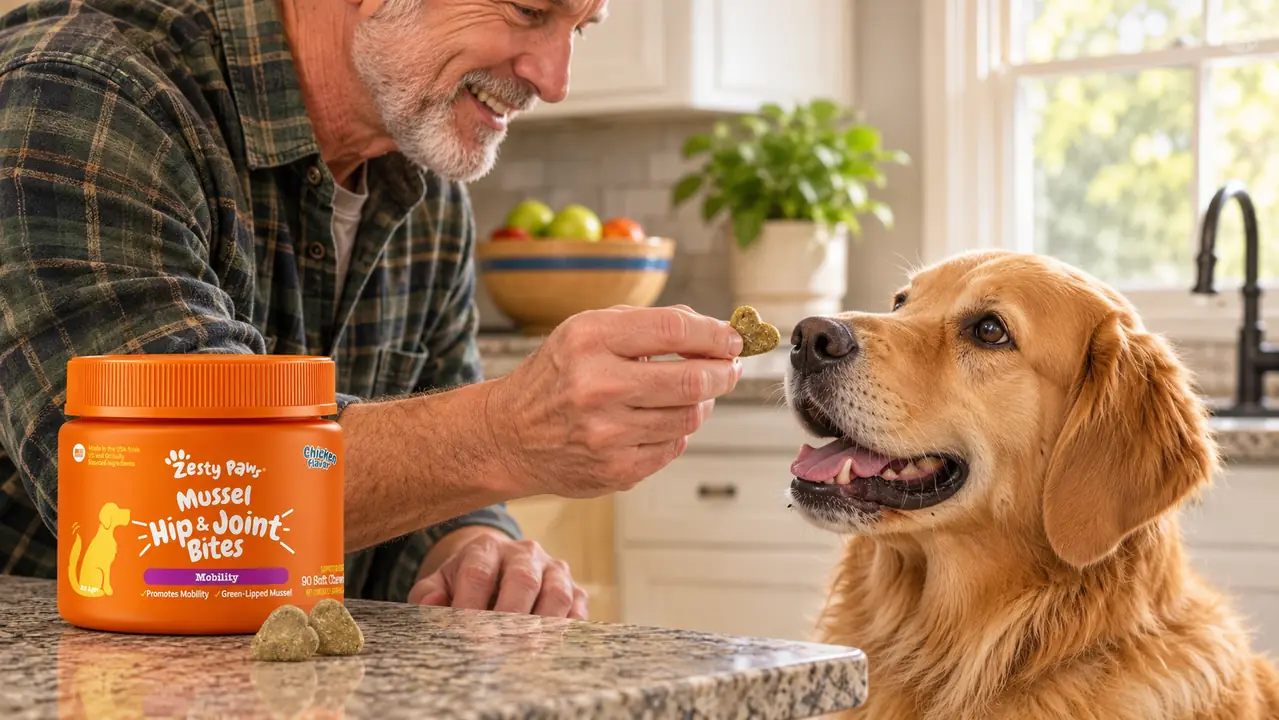
The Zesty Paws product is a soft chew, chicken and mussel flavored, sold as a 90 count tub that weighs 7.9 ounces. The mussel is green-lipped mussel sourced from New Zealand and cold processed, and the formula also carries natural glucosamine and chondroitin along with omega-3 fatty acids. The label calls it a limited ingredient chew, and that phrase deserves reading carefully: it means a shorter list than the kitchen-sink chews, not a promise that your dog tolerates every item on it. It is positioned for hip and joint support and for keeping a dog moving, which is exactly the job I was shopping for.
Fish oil is a different category of thing. It is a fat rendered from fish, and what you are really buying is EPA and DHA, two omega-3s that come up in the research on supporting a normal inflammatory response. You can buy it as a liquid or as capsules. Liquids are dosed by body weight and by the concentration printed on that specific bottle, which means two bottles of fish oil are not interchangeable and the label math is on you. Capsules travel better and are harder to get past a dog who knows how to eat around them.
How I Compared Them at Home
I am not a researcher and this was not a trial. I am a retired graphic designer in St. Paul with one dog and a fridge door covered in notes. Tucker had been on fish oil for about four months before I moved him onto the Zesty Paws chews for ten weeks, and I wrote down the same four things the whole time: how long he paused at the bottom of the stairs, how he got up off the wood floor in the morning, whether he hesitated at the back of the Subaru Outback, and how he walked the river trail on Saturdays.
Those four things tell you more than any rating on a product page. A stiff dog still wants the walk, and he will fake enthusiasm for the first ten minutes of it. So I watched the boring parts instead. The first three steps after he stood up. The last quarter mile on the way home. Whether he picked the carpet over the floor to lie down on. That is where a change shows up, if it shows up at all.
I kept a column for the practical things too. Did he eat it, how long did it take, was there any loose stool, did his breath smell like a seafood counter, did he start turning his head when he heard the tub open. None of that is clinical. All of it decides whether a supplement actually gets given on day forty, and a supplement that gets skipped half the time is not doing much of anything.
By the tenth week the pause at the bottom of the stairs was shorter. Not gone. Shorter. At his age, that is the kind of change I will take.
Where Zesty Paws Mussel Mobility Bites Wins
The biggest difference between these two had nothing to do with ingredients. It was the transaction at seven in the morning. A chew comes out of the tub, he takes it, we move on. Fish oil means a measuring spoon, a greasy bowl, a dog who sometimes walks away from breakfast because it now smells different, and a face that smells like a fish market for the rest of the morning walk. When you are managing a slow change in a ten-year-old dog, the version you will actually do every single day beats the version that looks better on paper. That is not a small edge. It is most of the decision.
The second advantage is that the Zesty Paws bites put the joint-specific pieces in one place. Green-lipped mussel, natural glucosamine and chondroitin, and omega-3s together, so I am not stacking three tubs and hoping the timing works out. For Tucker that meant one thing to buy, one thing to remember, and nothing that had to go back in the fridge after I opened it. I want to be honest about what that is and is not. It is convenience and consistency. Consistency is most of what any daily supplement has going for it, and a tub that sits on the shelf gets used.
Where Fish Oil Wins
Fish oil wins on control, and it is not close. A chew gives you a fixed amount, and the only lever you have is how many chews, which also changes how many calories you are adding to a dog who may not need them. A liquid lets you set the amount by weight and by the EPA and DHA numbers on that particular bottle. Those numbers swing widely between brands, so the bottle matters as much as the dose. If your vet has given you a target, a liquid is how you actually hit it.
It also wins on concentration and usually on cost per day. A good fish oil delivers more omega-3 per serving than a soft chew does, and for a seventy-pound dog the daily cost tends to run lower. A single-ingredient product is easier to troubleshoot too, because if something goes sideways you know exactly what changed. The catch is that all of this only counts if the dog eats it. I have known more than one Labrador who would happily disagree with that plan, and one who licked the oil off the kibble and left the kibble behind.
The Habit You Will Actually Keep: One Chew, No Measuring Spoon
Zesty Paws Mussel Mobility Bites put green-lipped mussel, natural glucosamine and chondroitin, and omega-3s into a single soft chew. Check the label against your dog's weight and run the dose past your vet first.
Amazon Check Today's Price on Amazon →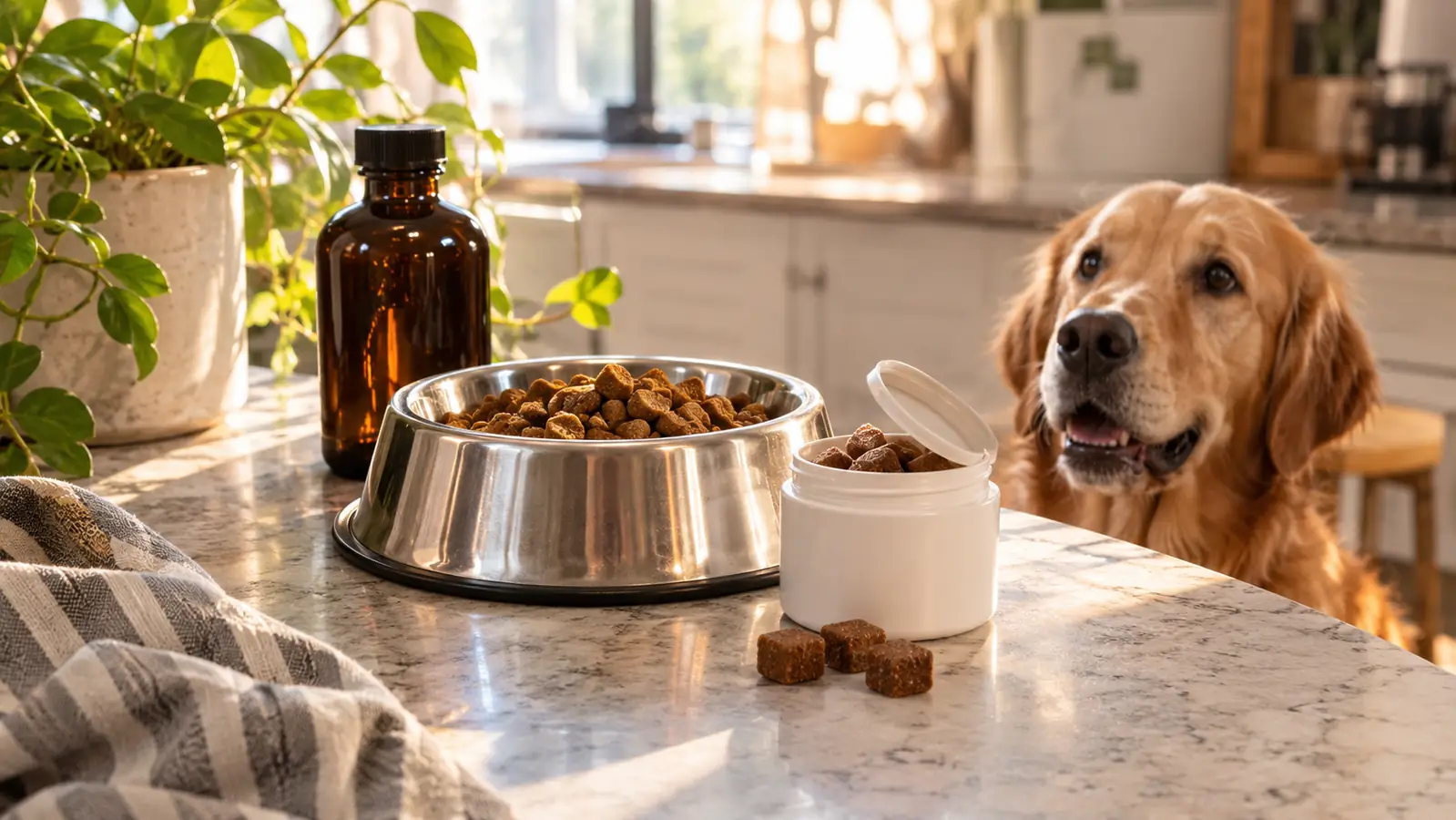
What My Vet Told Me About Using Both
Our vet's answer was less exciting than the internet's. Both are reasonable, she said, but they overlap. Mussel brings omega-3s and fish oil is omega-3s, so stacking them without thinking can mean a lot more of the same thing rather than broader coverage. She asked what Tucker weighed that day, whether his bloodwork was current, and told me to bring both labels to the next visit so she could read the actual amounts instead of the front of the package. That last part was humbling. I had been comparing marketing copy.
She also said the thing I now repeat to anyone who asks me about this. A supplement is not a diagnosis. If your dog is limping, favoring a leg, suddenly reluctant on stairs, or yelping when you pick him up, that is an exam, not a shopping decision. And give anything six to eight weeks before you decide, changing one thing at a time so you can tell what did what. If you start a chew and a new food and a new harness in the same week, you have learned nothing.
The Tradeoffs Nobody Puts on the Front of the Tub
The chew has real limits. It is chicken flavored, so a dog with a chicken sensitivity is a bad fit no matter how good the mussel is. Limited ingredient does not mean hypoallergenic, and it does not mean calorie free either, which matters for a dog who is carrying extra weight on joints that are already complaining. The dose is fixed per chew, so your only adjustment is quantity. And a soft chew is still a chew, which means some dogs bolt it and some dogs bury it in the couch cushions.
Fish oil has limits of its own. It oxidizes, which is why the bottle often wants the fridge and why an old bottle is not the same product as a fresh one. It can bring fishy burps, and a dose that climbs too fast can bring loose stool. Quality varies enormously from brand to brand, and the dosing math assumes you know your dog's weight on the day, not the weight from last year's paperwork. Neither product replaces the unglamorous stuff, which for us is keeping Tucker lean and walking him every morning whether it is convenient or not.
Who Should Buy Which
Buy the Zesty Paws Mussel Mobility Bites if your dog takes a soft chew like it is a treat, if you want joint-specific ingredients and omega-3s in one purchase instead of three, if you board him or travel and want something that lives on a shelf, and if the honest problem is that complicated routines get abandoned by week two. That last one is the real reason most people should pick a chew. Not because it is stronger. Because it gets given.
Buy fish oil if your dog refuses chews, if your vet has handed you a specific omega-3 target, if a lower daily cost matters right now, or if your dog is already on a glucosamine and chondroitin product and the only gap left is omega-3s. Skip both, at least for now, if there is a new limp, a sudden change, a sensitive stomach, or a dog on prescription medication. In those cases the phone call to the clinic comes before the shopping cart.
Where I landed: Tucker is on the Zesty Paws chews, with our vet's sign-off, mostly because he takes them without a discussion and I stopped dreading the morning routine. I keep a bottle of fish oil in the fridge for the stretches when our vet wants his omega-3 intake nudged, and I read the label every time I open a new one. If you want the longer view on green-lipped mussel itself, and the case for why it shows up in so many joint products, both are worth reading before you decide. The plain version is this. Match the product to the dog in front of you, not to the strongest claim on the page.
One Tub, One Chew, One Less Thing to Argue About at 7 A.M.
For the dog who walks away from a greasy bowl but never walks away from a treat. Confirm the dose for your dog's weight with your vet, then keep the habit simple enough to keep.
Amazon See Current Price on Amazon →