

Tucker started hesitating at the back of my Subaru Outback about a year ago. He is 10 years old, a Labrador mix, about 70 pounds, and for most of his life he treated a car ride like a personal invitation. Last winter he stood at the bumper, looked at the cargo area, and waited for me to lift him. That was the moment I stopped pretending the stiffness was just a bad morning. I started writing down what I saw: how long he paused before getting up, whether he took the stairs to the bedroom in one go, how he moved on our morning walk around the neighborhood. I also started looking for a daily joint chew that fit our routine. Zesty Paws Mussel Mobility Bites were one of the options I tried, and this is my long-term note on what happened.
I am not a veterinarian. I am a retired graphic designer in St. Paul who pays attention to small details, and I run changes like this past our vet. That matters with any joint product. Tucker had already been checked for the obvious problems, and our vet gave us a plan that included weight management, shorter but more frequent walks, and a soft bed. The chew was an addition, not a replacement. If your dog is limping, holding up a leg, or suddenly refusing stairs, start with a vet visit. A supplement is not a diagnosis.
The Quick Verdict
A practical chicken-mussel soft chew with green-lipped mussel, glucosamine, chondroitin and omega-3s. The changes were gradual and modest, and it is not a pain medication.
Amazon Check Today's Price →A daily chew for the dog who waits at the bumper
Zesty Paws Mussel Mobility Bites are soft chews with New Zealand green-lipped mussel, natural glucosamine and chondroitin, and omega-3 fatty acids. Check the current listing and confirm the label serving for your dog's weight with your vet.
Amazon Check Current Price on Amazon →How I've Used It
I followed the label for Tucker's weight instead of guessing. The bag is a 90 count, 7.9 ounce package, and the chews are chicken-mussel flavor. I kept the bag in the pantry next to his kibble so I would not forget. Each morning, after his first walk and breakfast, I gave him the chew and watched him take it. He is a Labrador mix with a Labrador's relationship to food, so I cannot claim he is a picky eater. He took it without turning his nose up, which is more than I can say for a powder I tried years ago.
The soft chew texture mattered. Tucker is 10, and his teeth are not what they were. A hard tablet would have been a negotiation. These are soft enough that he chewed and swallowed without me hiding them in peanut butter. I also liked that the bag is a 90 count because it did not turn into a weekly reorder. I still checked the label every time because the serving is based on weight, and I did not want to double up by accident.
We did not change his food, his walks, or his bed at the same time. That was on purpose. If you change five things at once and your dog improves, you have no idea what helped. The only new part of the routine was the chew. I kept the same morning loop around the block and the same weekend river trail. I wrote a note on the calendar at the start so I could look back.
What the Label Actually Says
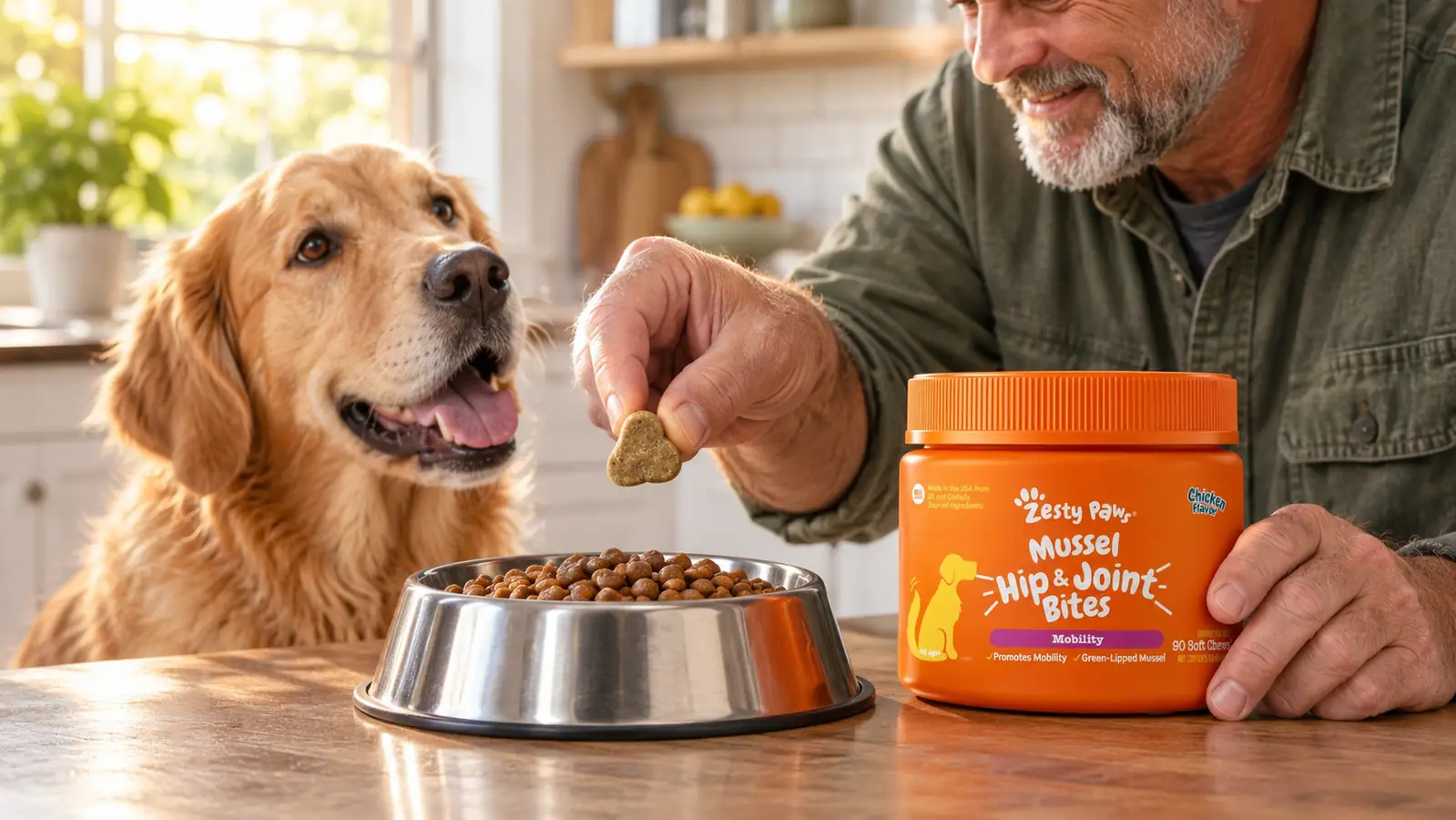
The product title is long, but the useful parts are simple. Zesty Paws Mussel Mobility Bites are soft chews made with New Zealand green-lipped mussel. The title also lists natural glucosamine and chondroitin plus omega-3 fatty acids. The listing describes the mussels as cold processed, and it puts the benefits under joint health, muscle health, antioxidant support and nutritional support. The flavor is chicken and mussel. The package is 7.9 ounces and holds 90 chews.
One detail I noticed: the listing data I saw lists chamomile under active ingredients. That is not a reason to avoid the product, but it is a reason to read the bag instead of trusting a product page alone. I checked our bag's panel and followed the label. If your dog is on medication or has a sensitive stomach, that panel is what you should bring to your vet. The listing is a summary, not a medical record.
The ingredient list is the reason I was willing to try it. Green-lipped mussel is the headline, and the added glucosamine, chondroitin and omega-3s are familiar names in joint support. I am not going to pretend I can measure which one did what. A chew is a blend, and Tucker is one dog. What I can tell you is that the formula matched the conversation I wanted to have with our vet, and the soft chew format matched the dog in front of me.
What Changed Over Six Months
The first two weeks were boring. That is the honest version. Tucker ate the chew, we went on our walks, and nothing about his movement looked different. I have been around enough senior dogs to know that joint products are not pain pills. They are not supposed to hit like a switch. I kept going because the routine was easy and our vet had approved it.
Around week four, I noticed the morning pause. Tucker used to gather himself before standing, front legs first, then a small hitch in the back. The pause did not disappear, but it got shorter. He was still stiff. He was still 10. But he stopped looking back at me as if he wanted me to do it for him.
The stairs were the clearer test. Our bedroom is upstairs, and Tucker had started stopping halfway. Not every night, but enough that I noticed. By the second month, he was making the trip in one go more often. He still took them slower than he did at seven. I am not going to tell you he bounded up them. He did not. The change was small enough that a houseguest would have missed it. I noticed because I was watching.
The Subaru came last. For months, Tucker had stood at the back and waited to be lifted. I had accepted it. One Saturday in the third month, I opened the hatch, and he put his front paws up on the bumper and looked at me. I gave him a boost, but he had made the first move. That was the moment I stopped thinking of the chew as nothing. It was not a cure. It was a small assist that made the rest of our routine easier.
By month six, the pattern held. Mornings were still his worst time. Cold, damp days were still worse than dry ones. The river trail was still his favorite, and he still trotted the first stretch with his nose down. The difference was recovery. After a long weekend walk, he seemed to get back to his normal pace a little faster. I cannot prove that with a score sheet. I can only tell you what I saw in my own house, with my own dog, over a stretch of months.
There were also weeks when nothing seemed different. I want to be clear about that. A rainy stretch in April made every morning look like a step backward. Tucker was stiff, I was tired, and the bag on the shelf did not feel like it was doing anything. Then the weather dried out and he moved better again. That is the problem with a one-dog review. You cannot separate the chew from the season, the walks, or the dog's own good and bad days.
Where It Fits in the Routine
The chew is not a substitute for the basics. Tucker's vet has been clear about weight. At 70 pounds, every extra pound is work. We keep his meals measured and his treats small. We walk every morning, and we do a shorter walk on days when he seems sore. The chew sits on top of that, not in place of it. If I used it as an excuse to skip the walks, I would be doing it wrong.
It also fits because it is a chew, not a powder or a pill. I do not have to crush it, mix it, or wonder whether he got the whole serving. He takes it from my hand. For a 10-year-old dog who has earned a little indulgence, that matters. The bag lives next to the kibble, and the habit is attached to breakfast. That is the only reason we have been consistent.

What I'd Want to Know Before Buying
First, set your expectations at daily support, not a fix. If your dog is in pain, this is not a replacement for a vet, a diagnosis, or prescribed medication. If your dog has a sudden change in movement, that is a vet visit, not a chew. I would say the same about any product in this category. The reason to try it is that it is easy to add to a routine and it contains ingredients you can discuss with your vet.
Second, check the flavor and the label against your dog's sensitivities. The chew is chicken-mussel flavor. If your dog has a food allergy or a sensitive stomach, ask before you start. The listing also says the mussels are from New Zealand and cold processed, which is the part Zesty Paws leans on. I care about sourcing, but I care more about whether my dog can tolerate the chew.
Third, give it time. I did not see anything in the first two weeks. If I had quit then, I would have missed the smaller changes later. That does not mean every dog will respond. Some will not. Some will have a sensitive stomach. Some will turn their nose up at the flavor. A return policy is not a reason to ignore the label. It is a reason to start small and watch.
Fourth, keep your vet in the loop. I brought the bag to our next appointment and asked whether the ingredients made sense with everything else Tucker takes. That is a five-minute conversation. It is worth more than any review, including mine. Your dog's weight, meds and kidney values are not in this article.
Fifth, do not expect a 90 count bag to solve the stairs. It is a convenience and a routine, not a guarantee. I still lift Tucker into the Subaru on some days. He still takes the stairs slower at night. The chew helped me feel like I was doing something consistent while we managed the rest. That is a modest goal, and it is the honest one.
What I Liked
- Soft chew that Tucker took without a fight
- Contains green-lipped mussel, glucosamine, chondroitin and omega-3s per the title
- Chicken-mussel flavor that suits a food-motivated dog
- 90 count bag fits a daily routine without constant reordering
- Easy to add alongside food, walks and vet care
Where It Falls Short
- Results were gradual and modest, not dramatic
- Not a pain medication and not a replacement for a diagnosis
- Chicken-mussel flavor may not suit dogs with food sensitivities
- You have to follow the label and keep the routine consistent
The change was small and slow. Tucker still had stiff mornings, but the pause before he stood up got shorter, and that was enough to keep the bag in the pantry.
Who This Is For
This is for the owner of a senior dog who has already had the joint conversation with a vet and wants a daily soft chew that is easy to give. It suits a dog like Tucker: 10 years old, around 70 pounds, stiff in the morning, slower on stairs, still eager for a walk. It also suits the person who will follow the label, keep the routine, and judge the result over months instead of days. If you want a chew with green-lipped mussel, glucosamine, chondroitin and omega-3s, Zesty Paws Mussel Mobility Bites are a reasonable option to discuss with your vet.
Who Should Skip It
Skip it if you are looking for a pain medication or a quick fix. Skip it if your dog has a known sensitivity to chicken or shellfish and your vet has not cleared the flavor. Skip it if your dog refuses soft chews, because a supplement only works if it goes in. And skip it if you are not willing to keep the rest of the plan, the weight control, the walks, the vet checks. A chew is a small piece of a larger routine. It is not a shortcut around one.
A smaller pause at the bumper is still a win
If your senior dog is stiff in the morning, start with a vet visit and a close look at the label. Zesty Paws Mussel Mobility Bites are a chicken-mussel soft chew with green-lipped mussel, glucosamine, chondroitin and omega-3s. Check the current listing, confirm the serving for your dog's weight, and give it time.
Amazon See the Zesty Paws listing on Amazon →