

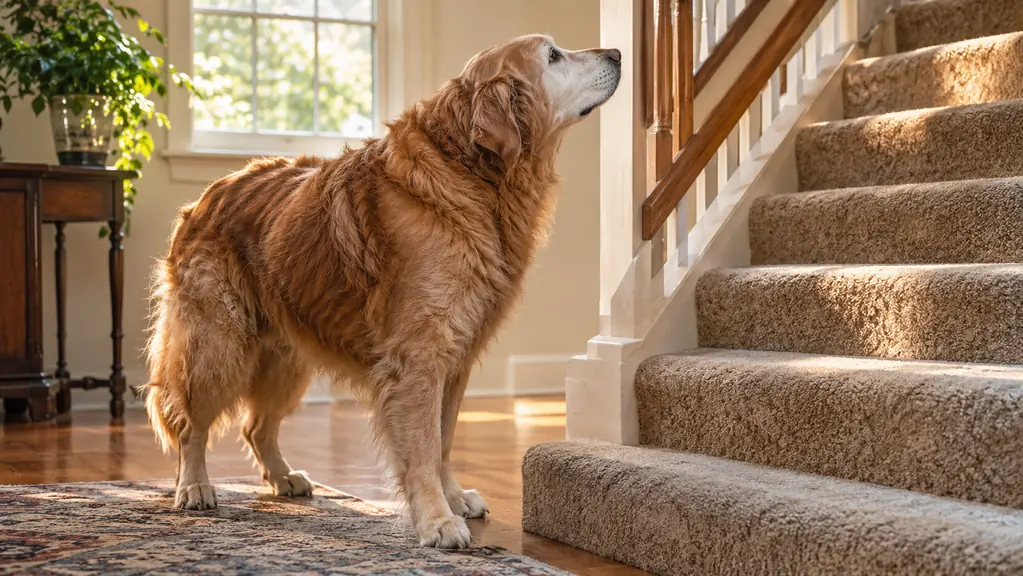
Tucker is ten years old, a Labrador mix, around seventy pounds, and for most of his life he took the stairs to the bedroom two at a time. About a year ago he started stopping on the landing to think about it. Then he started hesitating at the back of the Subaru Outback before jumping in. No yelping, no refusal to walk, nothing a stranger would notice. Just a dog who had begun to calculate a jump before he made it.
At his checkup our vet ruled out the things that need ruling out and then gave me the same three instructions she gives every owner of a dog this age: keep the weight down, keep him moving, and pay attention to what is in the bowl. Fish oil came up. I went home and read labels for two weeks before I bought anything, because the pet aisle has about forty bottles that all say omega-3 on the front. Nordic Naturals Omega-3 Pet is the one that ended up on my kitchen counter. What follows is not a marvel story. It is the routine I built around that bottle, in the order that actually mattered.
The bottle that survived two weeks of label reading
Unflavored liquid omega-3 for dogs and cats in a 2 fluid ounce bottle. If your vet has already given you a dose, this is a clean way to deliver it. If they have not, start there first.
Amazon Check Today's Price on Amazon →Step 1: Get a dose from your vet, not from a label
The bottle does not tell you how much to give a seventy pound dog, and that is on purpose. Dose depends on how much EPA and DHA are in that particular product, on your dog's weight, and on what else is going on with him. A dog with a history of pancreatitis, a dog on a medication that affects clotting, a dog who has had any reaction to fish: all three need a conversation before a bottle, not after.
So I asked. I brought the product page to the appointment, our vet looked at the EPA and DHA numbers, and she wrote an amount on the back of a receipt. She also told me to split it between two meals rather than putting the whole thing in one bowl, because a big single dose of oil on a quiet stomach is a good way to end up cleaning the rug.
Then write the amount on the bottle itself with a marker, along with the date you started. Six weeks from now you will not remember whether it was once a day or twice, and you will not remember when you began, and both of those things matter more than you think when you sit down to decide whether it is worth continuing.
Step 2: Pick the form your dog will actually take
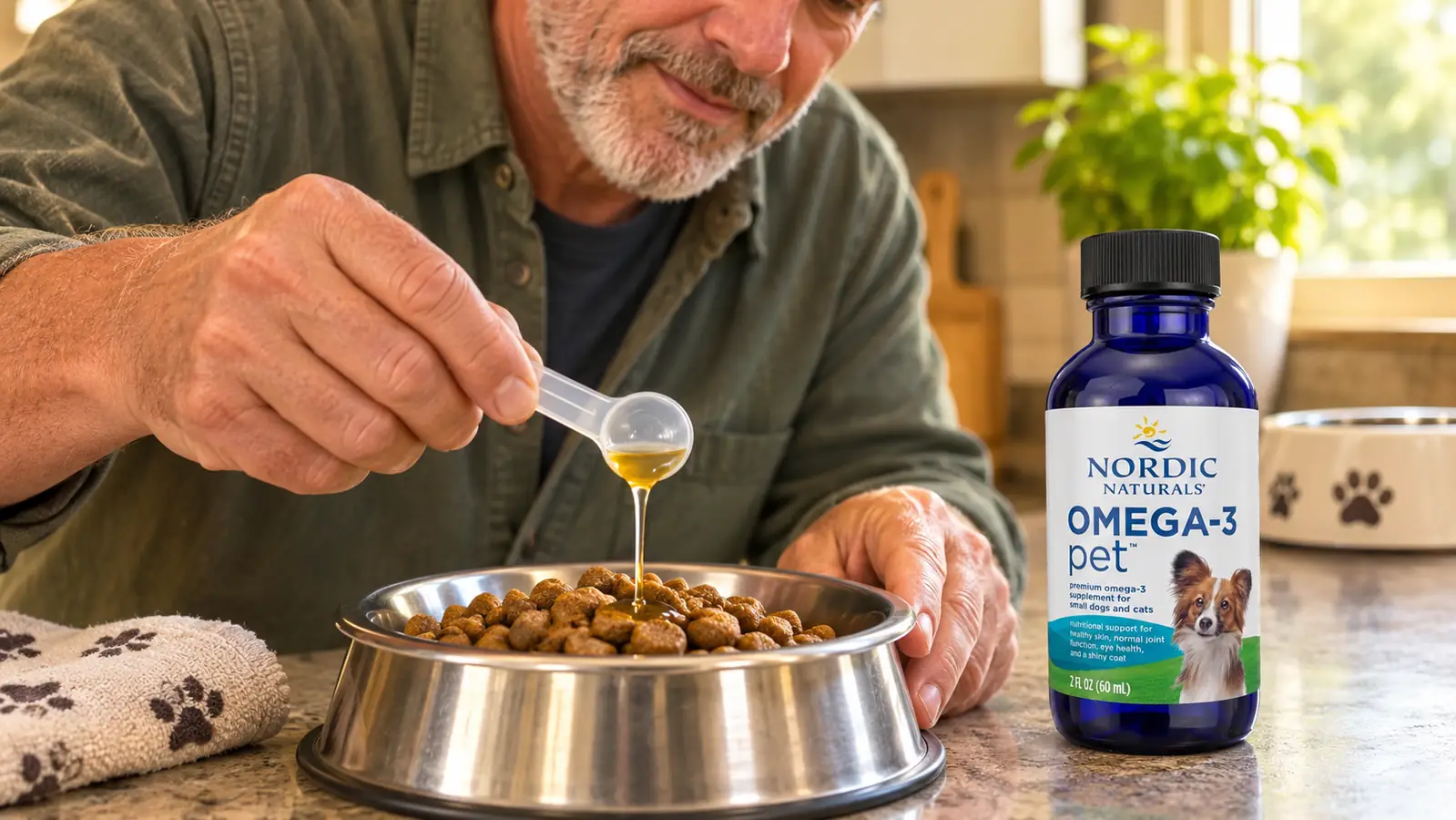
Fish oil comes as a liquid, as softgels, and baked into chews. A ten year old Labrador will take just about anything, which is not true of every dog, but the deciding factor for me was control. Liquid lets me adjust the amount by a hair if the vet changes it. Nordic Naturals sells this one unflavored, which sounds like a kindness and is really just the absence of a promise.
The honest downside is that the bottle is small. Two fluid ounces goes faster than you expect when you are dosing a seventy pound dog twice a day, so I buy two at a time and keep the spare in a closed cupboard rather than on the counter. Fish oil does not improve with heat or light. Check the date on the bottom, and if it smells sharply of fish the moment you open it, that is not a batch you want to keep.
I also keep the open bottle in a shallow dish on the counter so it does not get knocked over mid-meal. That sounds like a small thing until the morning it happens and you are wiping oil off a tile floor at six thirty with a dog watching you do it.
Step 3: Put it in a meal you already serve
I did not build a new ritual around this. Tucker eats at six thirty in the morning and five in the evening, and the oil goes into the morning bowl. I measure it into a small dish first, then pour it over a spoonful of wet food and stir, then put that on top of the kibble. If I poured it straight over dry kibble, half of it would end up on the bottom of the bowl and he would leave it there.
The reason to put it with food rather than on its own is simple. Oil on an empty stomach has more chance of coming back up, and a dog who vomits a supplement is a dog who is not getting it. Mixing it into something with a little texture also covers the taste for the dogs who notice. Tucker does not notice. My neighbor's retriever notices everything, and she stirs it into a quarter cup of wet food and stands there until the bowl is empty.
If someone else feeds your dog, or if he goes to daycare two days a week, the routine has to survive that. I pre-measure a week of portions into small lidded cups on Sunday night and leave a note taped to the food bin. It takes ten minutes and it means the Tuesday morning dose does not depend on anyone remembering a conversation from Sunday.
Step 4: Anchor it to something you already do
The reason most supplements fail is not the supplement. It is the third week, when the novelty is gone and you are late for something and the bowl gets filled without it. So I hung the habit on a fixed point: the bottle lives in the same cupboard as the food bin, and the scoop lives inside the food bin. Opening the bin means seeing the bottle.
I also marked it on the kitchen calendar, one small dot per morning, because I am the kind of person who will convince herself at eight in the evening that she already did it. Two weeks of dots tells you whether you have been consistent, which is the only question that matters when you start deciding whether something is working.
Step 5: Write down what you see for a month before you judge
Before the first dose I wrote four things on the back of an envelope: how long Tucker stands at the bottom of the stairs before he starts up, whether he jumps into the Outback on his own, how he moves on the first block of the morning walk, and how long it takes him to settle at night. That is my baseline. It is not scientific and it does not need to be.
Then I stopped watching. That is the hard part. A dog who is watched every single day for signs of improvement will produce them, because you want them. So I filled the bowl, made the dots on the calendar, and did not think about it until the end of the fourth week.
At four weeks the honest answer was this: his coat was better, noticeably, and the skin along his back was less flaky. His stairs were the same. At eight weeks the stairs were still the same, but he was stopping on the landing for a shorter time, and that one I trust because it was a separate line on the envelope. Your dog's version of this will be different, and some of it will be nothing.
The thing that changed was not the stairs. It was that he stopped standing at the bottom of them, deciding.
How to Tell If It's Working
The changes that show up first tend to be on the outside, because skin and coat turn over faster than anything else does. A softer coat, less flaking, less licking at the flank. Those are real and they are worth having, but they are usually not the reason any of us started.
The movement changes, if they come, come slowly and quietly, and they are easy to talk yourself into or out of. This is why the envelope matters more than your memory. If in three months the notes say the stairs are the same but the car jump is better, that is useful information for your vet, and it is far more useful than a feeling.
There is also a version of this where nothing changes at all. That is a real outcome and it is not a failure on your part. A bottle of oil is not a treatment. If eight weeks of consistent use produces no difference in your notes, you have learned something worth knowing, and you can stop without guilt.
I want to be careful here, because I read enough during those two weeks of label reading to know that fish oil is not a joint supplement in the way most people mean it. A bottle will not rebuild cartilage and it will not replace what a vet prescribes. The Nordic Naturals label lists coat, eyes, heart and immune support as what it is for, and those are the claims it stands behind.
What Else Helps
The single biggest thing, and the one nobody wants to hear, is weight. Every extra pound on a ten year old Labrador comes down on the same two back legs twice per step. Our vet gave me a target weight and I measured his food with a kitchen scale for a month. He lost four pounds over the summer and the stairs got noticeably easier before fish oil ever entered the picture.
The second is movement, in small amounts, often. A slow twenty minutes around the block in the morning does more for a stiff dog than one long hike on Saturday. Our weekend walk along the river trail is still our favorite thing, but I turn him around before he is tired rather than after, and that one change bought us more than any bottle.
The third is the house itself. I put a cheap runner at the bottom of the hardwood stairs and a small ramp in the back of the Outback. Both cost less than a second supplement and both changed how willing he is to get in the car.
And none of this replaces what your vet prescribes. If there is a real arthritis diagnosis, the plan usually includes pain management, weight control and sometimes physical therapy. A bottle of oil sits alongside those things rather than in place of them. Ours is the easiest part of the plan and the least important part, and I say that as someone who keeps buying it.
Who This Is For
This routine suits an owner with a dog in the second half of life, who already has a vet involved, and who wants a consistent way to get omega-3s in without a fight every morning. It suits people who will measure, write things down, and keep the bottle where they will see it. It suits a dog who eats with enthusiasm and does not turn his nose up at a slightly different bowl.
Who Should Skip It
Skip it, or at least stop and call your vet first, if your dog has a diagnosed fish allergy, a history of pancreatitis, or is on any medication that affects clotting. Skip it if your dog is a fussy eater who will refuse a whole meal over half a teaspoon of oil, because a supplement that costs you a meal is a bad trade. And skip it if you already know you will not keep up with it. Two weeks on and two weeks off is not a routine, and the bottle in the back of the cupboard is the most expensive thing in this article no matter what it cost you.
If your vet gave you a dose, this is a clean way to deliver it
Two fluid ounces of unflavored liquid fish oil for dogs and cats, with EPA and DHA, in the triglyceride form, non-GMO and free of artificial colors, flavors and preservatives. The bottle is small, so plan to reorder if you are dosing a big dog.
Amazon Check Today's Price on Amazon →