

Tucker is ten, a Labrador mix, about seventy pounds, and for most of his life he met me at the door. Last winter he started waiting on the rug instead. Then the stairs to the bedroom became a place he would stop halfway up and decide. About a year ago he began hesitating at the back of my Subaru Outback, front feet on the bumper, working something out. None of that happened overnight, which is why it took me so long to bring it up with our vet.
Our vet ran her hands along his hips, watched him walk away from her and back again, and told me what I already suspected: some arthritis, some stiffness in the lower back, a dog who was not in crisis but was not comfortable either. Fish oil was at the top of her list. Omega-3s, she said, are one of the few supplements with real research behind them for joint comfort, and she would rather I start there than with something expensive and unproven. Nordic Naturals Omega-3 Pet was the one I ordered.
The reasons were practical rather than romantic. The label lists the EPA and DHA in plain numbers instead of a proprietary blend. The bottle is two ounces, small enough that I was not committing to a year of something he might refuse. And it is liquid, which matters when your dog has already demonstrated that he will eat around a capsule and leave it in a neat pile at the bottom of the bowl. I have reordered it ever since, through two winters now, and it has outlasted every other thing I have tried for him.
The Quick Verdict
The bottle I have reordered more than a dozen times. Small, neutral enough to disappear into kibble, and specific about what is inside it. It is not a cure and it will not be, and the two-ounce size means you are buying it often.
Amazon Check Today's Price →The small bottle that stayed in my fridge door for two years
Two ounces, plain numbers on the label, and a dog who never once turned his nose up at it. Check the current listing for size and availability.
Amazon Check Today's Price on Amazon →How I've Used It
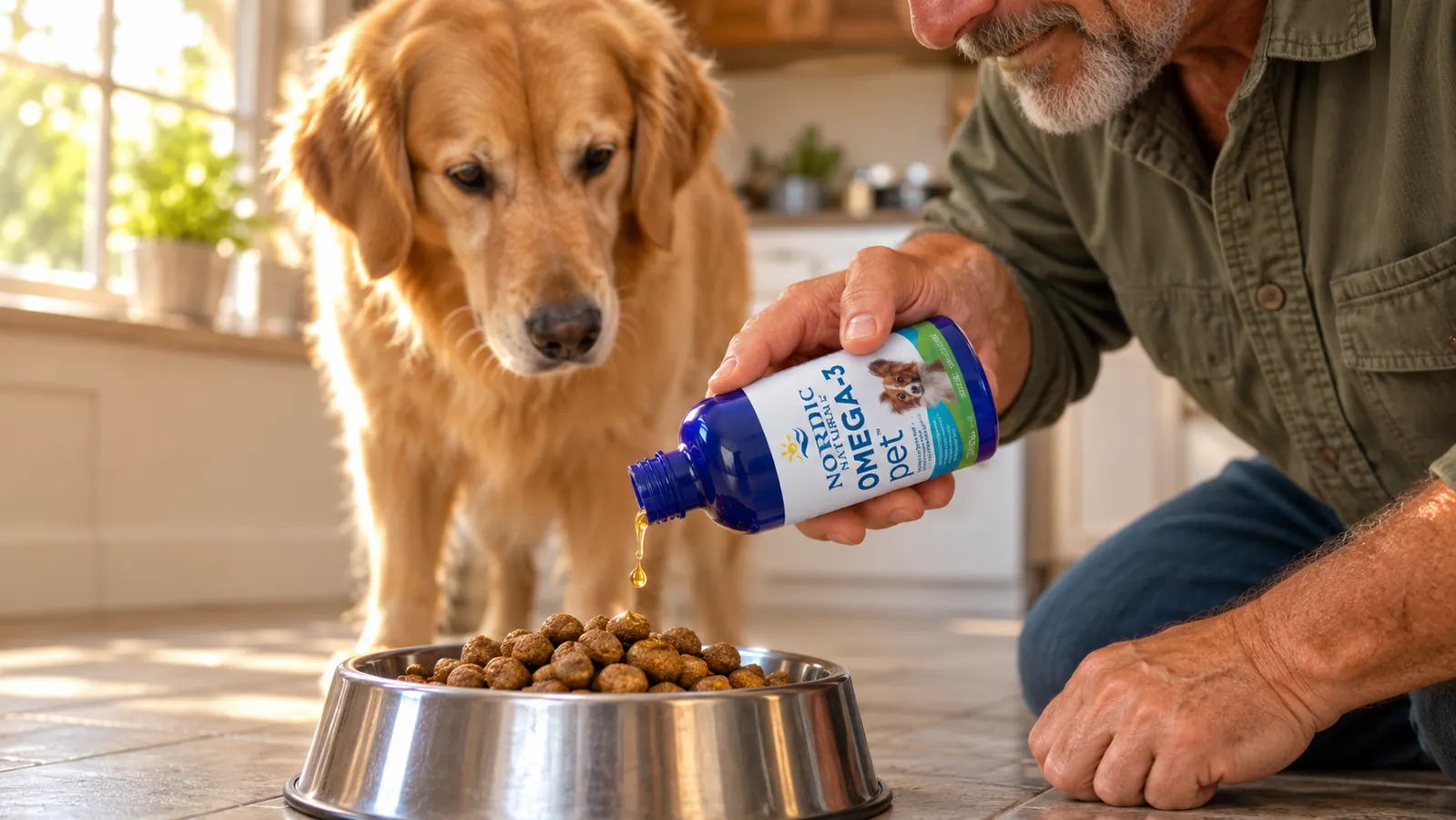
He gets it once a day, in the morning, poured over his kibble. Our vet gave me a starting amount based on his weight and we have not changed it since. I do not measure it into a spoon first. I tip it straight from the bottle onto the food and stir it in with my finger, which sounds careless but takes four seconds and means he never sees a separate step happening. The first week I stood there and watched him eat, waiting for him to turn his nose up. He did not. Whatever the oil tastes like to a dog, it is not enough to put him off a full bowl, and he has never left a slick of it behind.
The bottle lives in the door of my refrigerator, a habit left over from the fish oil capsules I used to take myself. Two fluid ounces lasts us a little over three weeks at his amount, so I reorder when I notice we are getting low rather than when we run out. The small size that made me choose it is the same thing that makes it a recurring purchase. I have made my peace with that. What I did not want was a large bottle of the stuff going stale in a cupboard, which is exactly what happened with the last supplement I bought in bulk.
There is one more piece of the routine, and it is not the oil. I cut his walks shorter and I stopped making him do the stairs twice a day. I lift him into the Outback when the ground is wet and let him manage it when it is dry. If I had only added the oil and changed nothing else, I would have a much harder time telling you whether it did anything. Our vet set the amount and she sees him once or twice a year. That is the arrangement, and I would not do it any other way.
What's Actually in the Bottle
The label says 294 mg of fish oil per serving, with the EPA and DHA broken out underneath as real numbers rather than a vague proprietary blend. That matters more than it sounds. Plenty of pet supplements advertise a large total for fish oil and then bury the two fatty acids that do the work in amounts too small to bother with. Nordic Naturals also states that the oil is in triglyceride form, which is the form those fatty acids take in an actual fish, rather than the ethyl ester form used in cheaper refining. I am not a chemist and I will not pretend I can tell the difference from the outside. What I can tell you is that this was the only bottle that answered all three of my questions: how much, in what form, and made by whom.
The rest of the label is a list of what is not in it. No artificial colors, flavors or preservatives. Gluten free and dairy free, and non-GMO. It is unflavored in the sense that nothing has been added to change the taste, not in the sense that it has no taste. It smells like fish, because it is fish. If you are squeamish about that, pour it with the window open and wash your hands after, and you will be fine. Nothing about it has ever bothered me except the first thirty seconds of the first bottle.
One note on the listing. It gives the breed size as small, which gave me pause, since Tucker is seventy pounds. I read that field now as a rough guide to the bottle itself rather than a limit on the dog. Our vet set his amount and the product has worked at that amount for two years. The label also says it is for both dogs and cats, which is worth knowing if you keep one of each and want a single bottle in the door of the refrigerator.
What Changed, Month by Month
I want to be honest about the timeline, because I read a lot of reviews before I bought anything and most of them described results inside a week. That was not our experience. The first month, nothing changed that I could point to. He ate his food. He got up off the floor the same way. He took the stairs the same way. I kept going because our vet had told me it would take a couple of months before I knew anything, and because stopping at three weeks would have told me nothing at all. Around week six I noticed he was getting up in one motion instead of two. Then I noticed I had stopped noticing, which is its own kind of result.
By the third month the stairs had changed, and that is the change I would point to if you asked me for a single one. He used to take them in a stutter: front paws up two or three treads, a pause, then the rest. Now he goes up in a steady line. He still climbs slower than he did at six years old. I am not going to tell you he bounds up them. He is ten, he has arthritis, and no supplement is going to give me a puppy back. But the pause is gone, and the pause was the thing that made me feel like I was watching him get old in real time.
By the third month I had stopped looking for a big change. I was watching him take the stairs without stopping halfway, and that was enough.
The Outback is still the honest test. He hesitates at the bumper sometimes, especially when the ground is wet, and I lift him in maybe one time in four now instead of every single time. The other three he manages himself, and he does it without that long pause at the start. His coat, which I did not expect to notice, looks better than it did last winter, less dry along the back. I cannot tell you the oil did that. Winter is dry in Minnesota regardless. But it is the sort of thing you notice when you are already looking at your dog more closely than you used to.
At his last check our vet said his weight was steady and his gums looked good. She did not credit the oil and I did not ask her to. It is one input in a routine that also includes shorter walks, a joint-friendly food, and me being less stubborn about making him do the stairs twice a day. If you want more on what the research actually says about fish oil and older joints, I would point you to it rather than mangle it here, because I am reporting what I saw in one dog and that is all I can honestly report.
The Parts Nobody Mentions
Two ounces is not a lot. I go through a bottle in a little over three weeks, which means I think about this purchase somewhere around seventeen times a year. If you are the sort of person who wants to buy a thing once and forget it, that will annoy you, and it should. There are larger bottles, and there are softgels and powders. I stay with the small bottle because I once watched a large bottle of fish oil go off in a cupboard, and that is simply money in the bin. The size is the tradeoff and I took it with my eyes open.
The allergen line says fish, plainly. If your dog has ever had a reaction to fish or fish oil, this is not the product to try on a whim. Ask your vet first. I would also say, gently, that if your dog is on any medication, especially anything that affects clotting, that is a conversation to have before you pour anything over the food rather than after. And it is not a painkiller. On a bad week, when the weather turns cold and damp and he is stiffer than usual, I still call our vet. The oil is a small daily input, not a treatment plan.
I also wish the label gave amounts for a range of weights instead of a single serving figure, because I ended up asking our vet and you may too. That is a small complaint about packaging, not about what is in the bottle. I mention it because I would rather tell you the annoying parts than have you find them yourself. Nobody's dog is the same weight, and a bottle aimed at both cats and seventy pound dogs has to say something general.
What I Liked
- Small bottle, so you are not committing to a large quantity of something your dog may refuse
- States EPA and DHA as plain numbers and names the triglyceride form
- Neutral enough that a seventy pound dog eats it over kibble without noticing
- No artificial colors, flavors or preservatives, and gluten free and dairy free
- Labeled for cats as well as dogs if you keep both
Where It Falls Short
- Two fluid ounces goes quickly at a daily amount and means frequent reordering
- It smells like fish, because it is fish
- Contains fish, so it is off the table for a dog with a fish allergy
- No substitute for vet care on a bad day

What We Tried Before This
We started with a softgel from a brand I will not name, because it was simply what the pet store had on the shelf. Tucker ate the kibble and left the capsules in a neat pile at the bottom of the bowl, every single morning, for two weeks. Then I tried opening them and squeezing the contents over his food. That worked, and it also took five minutes and left my fingers smelling like a fish counter for the rest of the morning. The liquid solved a problem that had nothing to do with ingredients and everything to do with compliance, his and mine.
I also looked hard at the salmon oil products, and I still think that is a reasonable road to walk. There is a full comparison worth reading if you are deciding between the two, and I will point you there rather than repeat it badly. My short version is that both are omega-3 sources and the difference comes down to the numbers on the label and what your dog will actually eat. What settled it for me was the size of the bottle and the fact that I could read the label without my glasses. The Nordic Naturals version is the one that survived two years of a routine, which is the only test I really trust.
Who This Is For
This is for the owner of a dog who is slowing down in the ordinary ways. Stiff getting up off the floor. Slower on the stairs. A little more thinking before a jump into the car. If your vet has ruled out the big things and told you to start with the basics, this is a sensible first thing to try. It is also for the person who has already been beaten by a powder their dog refused, and who wants something they can hide in food without a fight every morning.
It suits dogs of most sizes, despite the small breed size on the listing. Tucker is seventy pounds and has done well on it. If you have a smaller dog, the bottle goes further and the reordering annoyance shrinks accordingly. If you have a cat, the label covers that too, though I have no first-hand experience there and would not pretend otherwise. And if you are the kind of owner who wants to see the numbers on a label before you buy, this is one you can actually read.
Who Should Skip It
Skip it if your dog has a fish allergy. That one is not negotiable. Skip it if you are looking for something to manage pain on a bad day, because this is not that and it will not become that. Skip it if you know in your heart that you will not keep up with a daily addition, since a supplement given three times a week is a supplement you cannot evaluate. And skip it, for now, if your dog is due for a vet visit you have been putting off. Get the diagnosis first. I delayed ours for most of a year because I did not want to hear it, and I would take that year back if I could.
What I would tell a friend is simpler than all of this. If your dog is ten and stiff and your vet says the joints are just wearing down, a small bottle of fish oil and a shorter walk is not a bad place to start. It is not dramatic. It is not fast. It cost me less than the last thing I bought and threw away, and it has been in my refrigerator door for two years. That is the whole review.
Start with the small bottle, not the big one
Two ounces is enough to find out whether your dog will eat it and whether you will keep up with it. That is the whole test.
Amazon Check Today's Price on Amazon →