

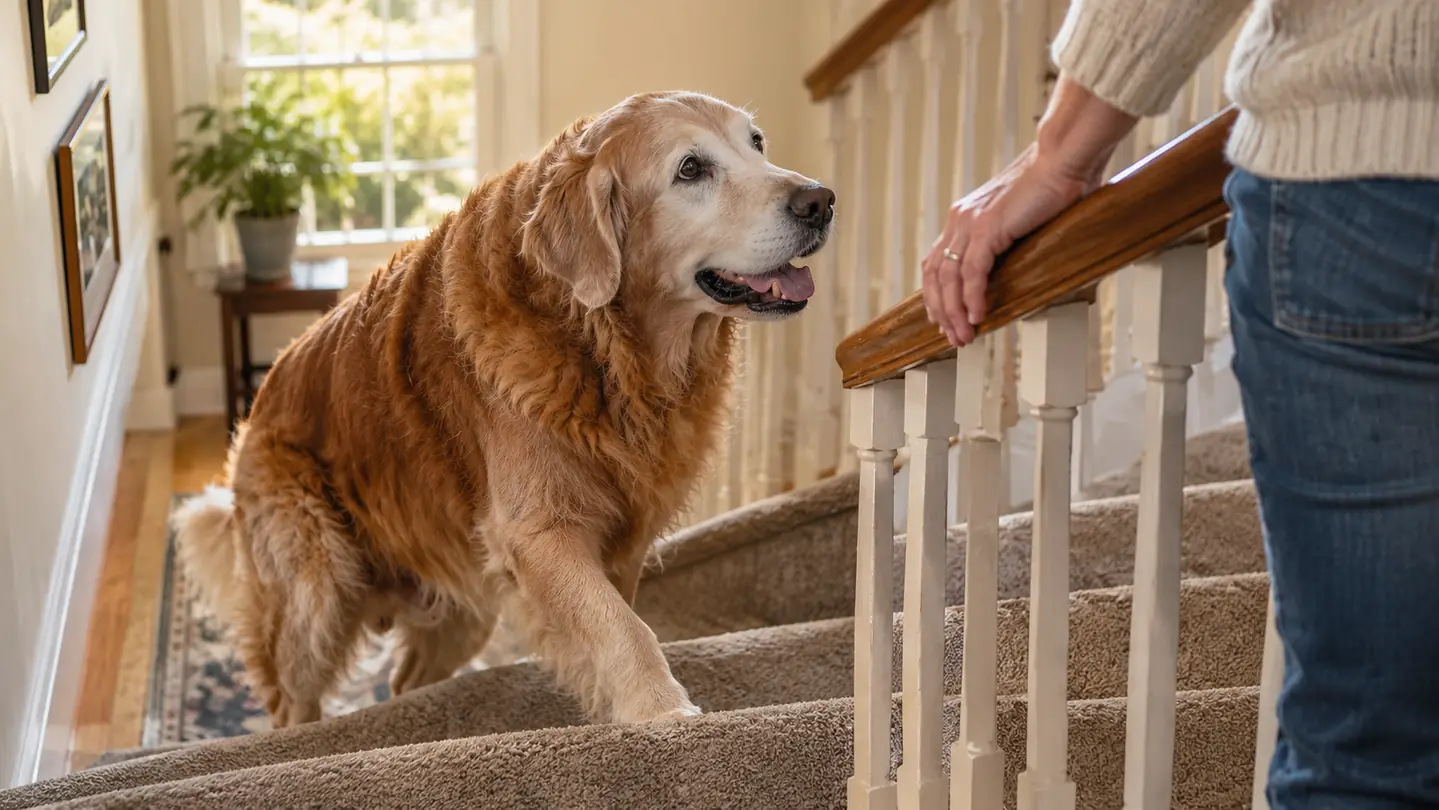
Tucker is ten, a Labrador mix who weighs about seventy pounds and still acts like a puppy until roughly seven in the morning. That is when I hear it. The pause before he stands up. The small gathering of his back legs underneath him. The two seconds where he stands still and decides whether the stairs to the bedroom are worth the trouble. About a year ago he stopped hopping into the back of my Subaru Outback without a running start, and that was the detail that finally got me to pick up the phone. Our vet said what vets usually say, that it is ordinary wear in an older dog's joints, and recommended a supplement with glucosamine and chondroitin. We started with Cosequin Maximum Strength from Nutramax Laboratories. What follows is our routine, in the order we did it, including the parts that actually mattered.
Before that, I tried the things people try. I bought an orthopedic bed, which he ignored for a week and then claimed as his own. I shortened the morning walk around the neighborhood. I put a rug at the bottom of the stairs. All of it helped a little and none of it changed the morning. If you are in the same spot, standing in your kitchen at seven in the morning watching your dog think about standing up, here is what I would do in your shoes.
The bottle our vet named first is the one still on my counter
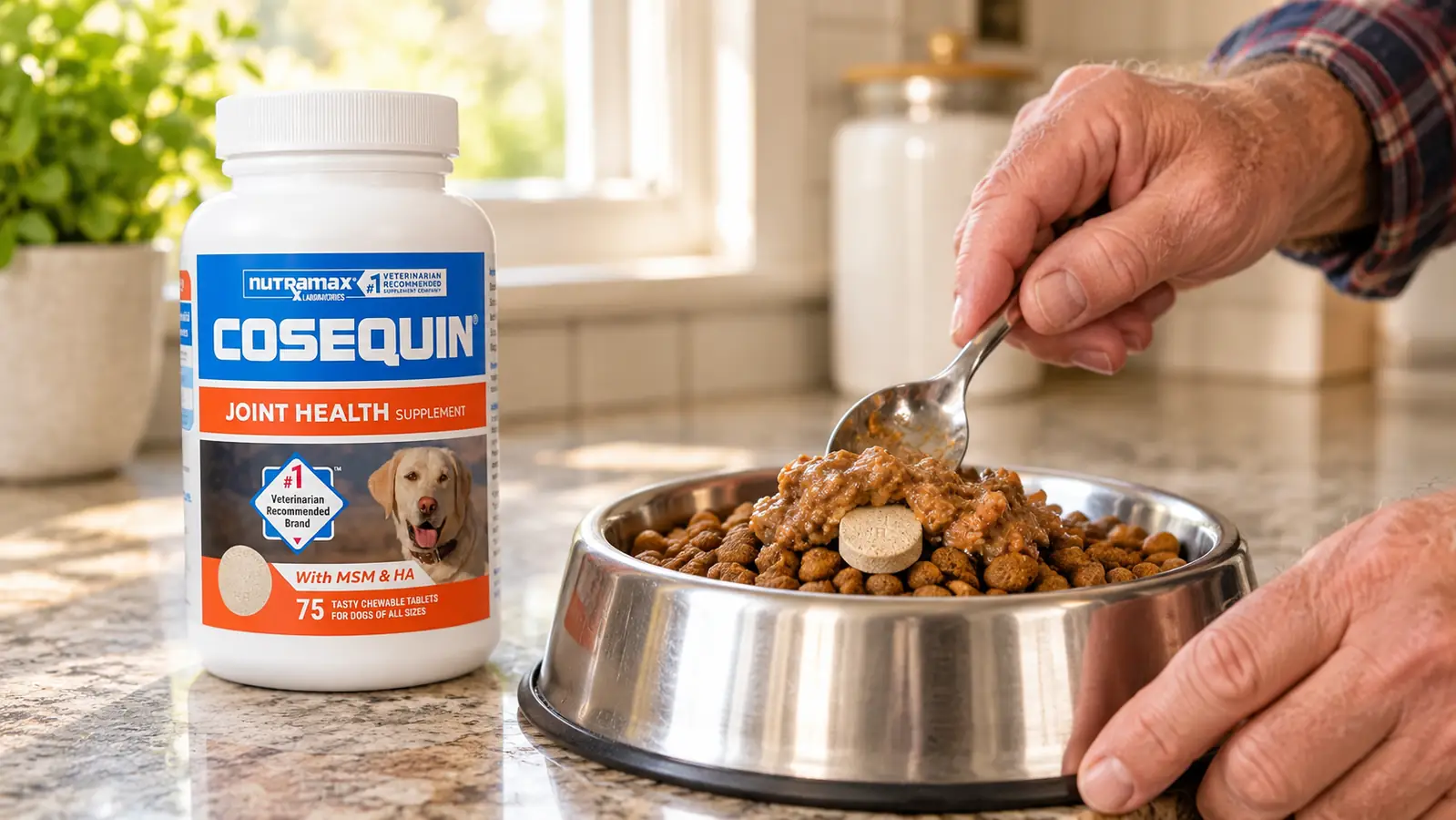
Cosequin Maximum Strength is a chewable tablet with glucosamine hydrochloride, sodium chondroitin sulfate, MSM and hyaluronic acid, made by a company that has been in pet health for over 25 years. Check today's price and read the current weight chart on the label before you start.
Amazon Check Today's Price on Amazon →Step 1: Get a baseline before you change anything
The single most useful thing I did cost nothing. I took a fifteen second video of Tucker getting up from his bed on a Tuesday morning, before we started anything. It is not flattering to either of us. It is also the reason I know the supplement is doing something, because six weeks later I watched the two clips side by side on my laptop and saw a difference in how his back legs came under him that I would have argued myself out of noticing in real time.
Our vet did the rest of the baseline. She moved each of his back legs through its range, pressed along his hips, watched him walk away from her and turn around and come back. She asked when he was stiffest, and the answer was mornings and after a car ride, which she said was typical. She weighed him too, because the amount on the label is tied to weight and a seventy pound dog and a seventy five pound dog do not get the same thing out of a bottle.
Write down three things while you are thinking about it. The time of day your dog is stiffest. How long the stiffness lasts once he gets moving, in minutes. And one specific thing he has stopped doing, like jumping into the car or taking the stairs at a run. Those three notes are your measuring stick for the next two months, and they will be more honest than your memory.
Step 2: Follow the label's starting amount for the full starting period
This is where I almost got it wrong. The label gives an amount to start with and a lower amount to hold at later, and they are not the same number. I read the first one, decided it seemed like more than necessary, and gave him the lower amount from day one. Four weeks later nothing had changed and I was ready to call the whole thing a waste of money. Our vet asked one question, which was whether I had done the starting amount for the full stretch it calls for. I had not.
The starting amount exists for a reason. This is not a pain pill that works in an hour. The ingredients have to build up, and the directions are written around how long that takes. If you skip ahead to the maintenance amount, you have cut out the part that makes the rest of it work, and you will conclude the product failed when it never really got a chance. Follow the label for your dog's weight. If your dog sits between weights on the chart, that is a question for your vet, not a guess.
Bottle size matters more than I expected. Ours came as 75 chewable tablets, and once I was giving the correct starting amount, it went faster than I thought it would. Nutramax Laboratories prints the weight chart on the label, and the chart is the thing to read, not the number of tablets sitting in your cupboard. Buy the larger count if you already know you are in this for longer than a month.
Six weeks in, the pause before he stood up went from about four seconds to about one. I counted, because I am that person.
Step 3: Make the tablet easy enough that he takes it without a fight
Tucker is food motivated, which is a polite way of saying he will eat almost anything, and even he needed a routine. The tablet is chewable, so the first few days I just handed it to him. That worked until it did not, and then he started taking it and dropping it on the floor beside his bowl. What fixed it was putting it on top of his kibble with a spoon of wet food over it, then walking away. Standing over him and watching turned a snack into a negotiation.
If your dog is a gulper, watch the first few meals to make sure the tablet actually goes down and is not being sorted out and left behind. If your dog is picky or on the small side, ask your vet whether the tablet can be broken or crumbled into food before you do it, and get that answer for your dog specifically. Some dogs do better with a soft chew or a powder, and that is a conversation worth having early rather than after you have bought a second bottle.
Keep it in one place and give it at one time. Ours lives next to the coffee maker, because I am in front of the coffee maker every morning and the tablet goes into his bowl before my coffee finishes brewing. A supplement that depends on you remembering is a supplement that gets missed three days a week by the second month.
Step 4: Put it on the schedule of his hardest part of the day
I give it with breakfast, roughly an hour before the morning walk. That is not a clinical recommendation, it is just what fits the shape of our day and what our vet was fine with. The point is that mornings are when Tucker is stiffest and mornings are when the walk happens, so the routine is lined up with the part of the day that needs the help.
It also made the tracking clean. Same food, same time, same walk. When you are trying to work out whether something is helping a dog who cannot tell you how he feels, you want the rest of his day to be boring and repeatable. We kept the route the same for the first two months, the same loop around the neighborhood, and I timed it. That number came down by about four minutes over six weeks, which is not dramatic and is not nothing.
The weekend river trail walk was the one thing I did not touch. I wanted one comparison that was not part of the experiment. He is slower on the trail than he used to be, and he still is, and I would rather know that honestly than pretend a supplement fixed everything. An older dog who is slowing down is not a problem you solve once. It is a thing you manage, and managing it well means keeping some measurements that are allowed to disappoint you.
Step 5: Give it six to eight weeks and change one thing at a time
Six to eight weeks is the window our vet gave me, and it is longer than most people last. The temptation is to add three things at once, which means you learn nothing about any of them. For the first two months we changed exactly one thing, the Cosequin. No new food, no new harness, no new bed. The rug at the bottom of the stairs was already there, so it stayed.
At the end of each week I wrote one sentence in a note on my phone. Most of them are dull. Week three: stiff for about the same time, maybe a little less. Week five: stood up on the first try three mornings in a row. Week seven: went up the stairs ahead of me. Those sentences are worth more than my memory, which by week seven had already started telling me he was better than he probably was.
The one I keep coming back to is the car. He still will not jump into the back of the Outback from a standstill and I do not expect him to. What changed is that he now puts his front paws on the bumper and waits for me to lift his back end, instead of standing in the driveway looking at the bumper and then looking at me. That is a small thing to anyone else. It is the kind of change I was actually hoping for, and it is why a bottle from Nutramax Laboratories is still sitting on my counter a year later.
What Else Helps
The supplement is one lever, and it is not the only one. The biggest is weight. Our vet wants Tucker at about sixty eight pounds and he was seventy, which sounds like nothing and is not nothing to a set of back legs carrying him up a staircase twice a day. We cut back slightly on treats and dropped the extra evening biscuit, and he lost those two pounds over about three months without any drama.
The second lever is the floor. We have hardwood in the hallway and there is a runner on it now, plus rugs at the top and bottom of the stairs. A dog who is already careful about his back legs gets more careful on a slick surface, and more careful means shorter strides and longer hesitation, which reads as worse stiffness than he actually has. Traction is cheap and it changed how he moves through the house.
The third is the warm up. Instead of starting the walk at normal pace, the first five minutes are slow, with a lot of sniffing, which Tucker considers his job. Our vet called it a warm up and I called it letting him be a dog, and either way the middle of the walk looks better than it did when we started cold. Shorter and more frequent beats one long push, especially on the weekend.
And the fourth is the car. I stopped expecting him to jump into the Outback. He puts his front paws on the bumper, I lift his back end, and we go. There are folding steps and ramps made for exactly this and plenty of people use them. I keep meaning to buy one. In the meantime, lifting takes thirty seconds of my day and it saves him a bad landing on the driveway.
One last thing, and it is the one I would say loudest. Do not adjust the amount on your own. If four weeks pass and nothing has changed, the answer is a call to your vet, not a doubled tablet. Stiffness in an older dog can come from more than one place, and the only person who can tell you what you are actually dealing with is the one who can put hands on your dog.
Start it the way the label says, then give it eight honest weeks
Cosequin Maximum Strength combines glucosamine hydrochloride, sodium chondroitin sulfate, MSM and hyaluronic acid in a chewable tablet, from Nutramax Laboratories, a company that has been a leader in pet health for over 25 years. Read the weight chart, hold the starting amount for the full period, and keep a note on your phone. Then go check today's price.
Amazon Check Today's Price on Amazon →