

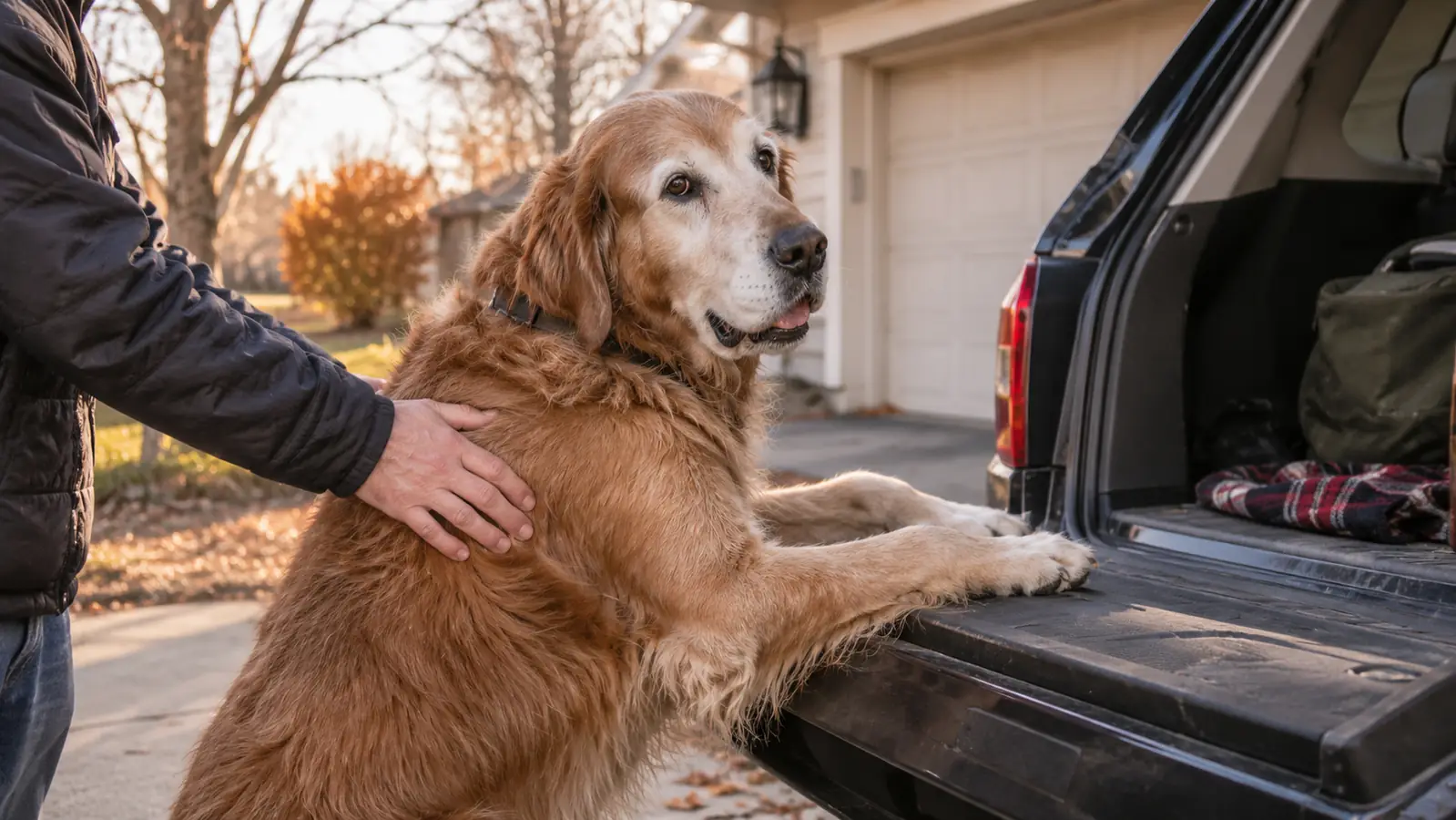
Tucker turned ten this spring, and the change arrived so slowly that I nearly missed it. He started pausing at the bottom of the stairs before going up to bed. He would stand at the open hatch of my Outback, look at the cargo floor, and wait for me to lift him instead of jumping in the way he used to. No yelping. No limp I could point to. Just a dog who used to take the stairs two at a time and now took them one at a time, with a rest on the landing.
I read labels for a few weeks before I bought anything. Cosequin, made by Nutramax Laboratories, is where I landed, and I have now been through enough bottles to have an opinion worth sharing. Nothing about this review is sponsored. Nobody sent me a free bottle and nobody asked me to write it. This is the version I would give a friend at the dog park: what changed, what did not, and the parts of the label that deserve a second look.
The Quick Verdict
A well-made maintenance supplement that helped my stiff ten-year-old Labrador mix, slowly, and only as one part of a bigger routine. It is not a painkiller and it will not rebuild a bad hip.
Amazon Check Today's Price →The one I actually kept reordering after the first bottle
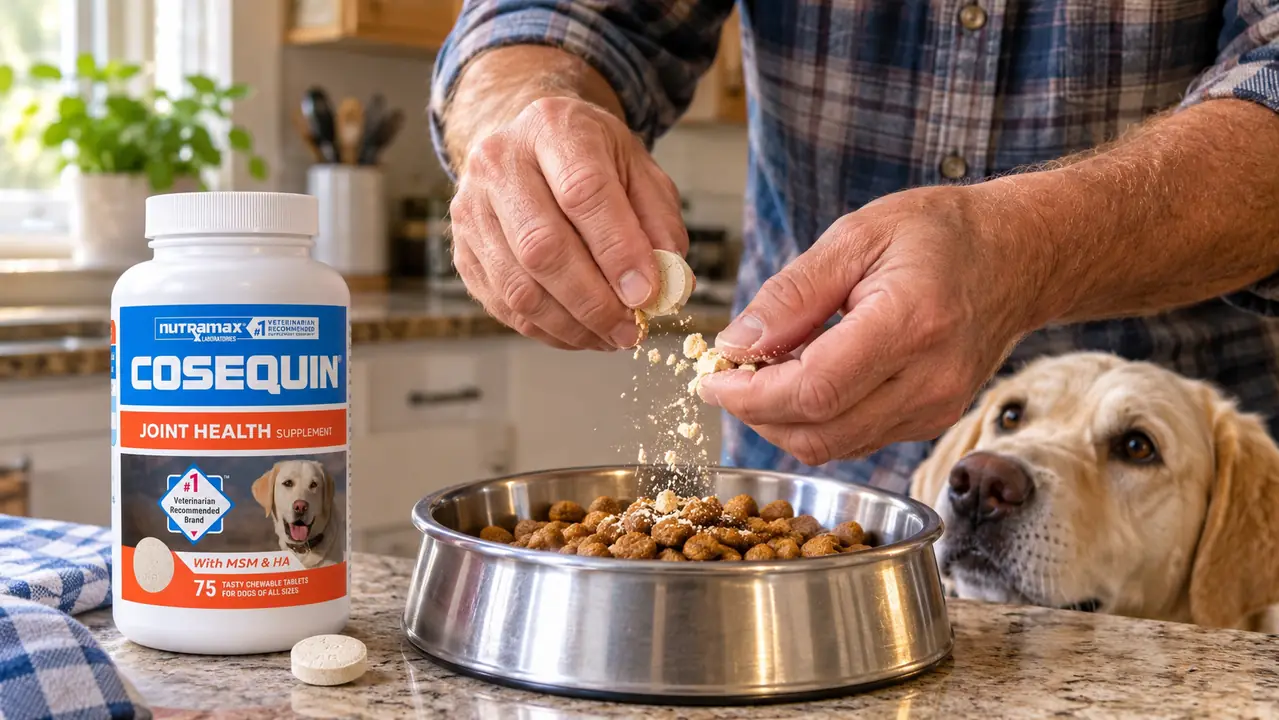
Cosequin Maximum Strength chewable tablets, 75 count, from Nutramax Laboratories. Glucosamine, chondroitin, MSM and hyaluronic acid in a chewable my picky dog would still eat crumbled over dinner.
Amazon Check Today's Price on Amazon →What This Review Is, and What It Isn't
I am not a veterinarian. I am fifty-eight, I live in a two-story house in St. Paul, and I have exactly one dog. What I have is a notebook, a year of mornings, and a habit of writing things down. I spent thirty years as a graphic designer noticing small differences between typefaces, and it turns out that is the same skill you need to notice small differences in how a dog moves.
What this review is not: a diagnosis, a dosing plan, or a promise. Joint supplements for dogs are not drugs. They are not held to the same standard, they do not work like a painkiller, and nobody can tell you from across the internet whether your dog's stiffness is arthritis, a soft tissue strain, or something a vet needs to see in person. Tucker gets checked once or twice a year and I would not have started him on anything without that conversation. Our vet is the one who decides what he takes. I am the one who decides whether to keep buying it.
So here is what I can tell you honestly: what is in the bottle, how I used it, when I noticed something, when I did not, and who I think should walk right past it.
How I've Used It With Tucker
Tucker is a Labrador mix, about seventy pounds, ten years old, stiff when he gets up in the morning and slower on the stairs. The bottle I buy is the Maximum Strength chewable tablet version, seventy-five tablets, and it lives in the cabinet next to his food. The label gives a weight-based chart rather than one flat instruction, so I asked our vet to confirm the number for his weight before I started.
The first three times I offered a tablet plain, Tucker sniffed it, took it into his mouth, and set it down on the floor. That is not really a knock on the tablet. He is a dog who once refused a piece of cheese because it had been in the same room as a pill. I started crumbling it over his morning kibble with a little warm water and he has cleaned the bowl every day since, which is the whole test as far as I am concerned.
He gets it in the morning, before our walk around the neighborhood. Not because morning is magical, but because I have a cup of coffee at the same time and I will not forget. On weekends we do the longer walk along the river trail, and that is the one where I really watch him. Watch the back end. Watch whether he slows on the return leg. Watch whether he plants his feet and stands there instead of sitting down.
What Nobody Tells You About Joint Supplements
The first thing nobody tells you is that you will not see anything for weeks, and you will spend those weeks convinced you wasted your money. Glucosamine and chondroitin are not painkillers. They are not absorbed and switched on like a light. Whatever they do, they do it at the pace of a slow season, and if you are squinting at the bottle looking for a sign on day nine, you are going to be disappointed.
The second thing is that improvement is genuinely hard to see, because dogs are so good at adjusting. Tucker did not go from stiff to spry. What happened is that the morning stiffness got shorter. Somewhere around six or seven weeks in, I realized I had stopped hearing him sigh when he got up off the kitchen floor.
The third thing, and this one matters most: you cannot trust your memory of how your dog was three months ago. You have to write it down. I noted three things every few days. How long he stood at the bottom of the stairs before starting up. Whether he jumped into the car or waited to be lifted. Whether he made it to the far end of the block on the evening walk or turned us around early. Forty seconds of writing. Without it I would have been guessing, and guessing is how people end up buying something for two years that never did anything.
The last thing is the label itself. Cosequin's packaging calls itself the number one vet recommended retail joint health supplement brand, and there is an asterisk next to that line which you should actually go read. It means a survey of veterinarians, about retail brands, at a point in time. It is not a clinical trial and it is not a promise for your particular dog. Nutramax Laboratories has been making this line for decades and that track record is worth something real, but the badge on the front is marketing, and knowing that keeps your expectations where they belong.
The first real change was not that Tucker got better. It was that he stopped getting worse, and I only knew that because I had written it down.
The Timeline, Honestly
Weeks one through three: nothing. He ate it, he was fine, his gait was the same as it had been in March. I noted it and kept going, because I had read enough to expect this part.
Weeks four through six: I started to think I was imagining things. There were two mornings where he came up the stairs without the pause at the bottom, and I wrote it down and underlined it, and then did not see it again for a while. This is the stretch where most people quit. I understand why.
Weeks seven through ten: the car. Tucker had stopped jumping into the Outback about a year before, and one Saturday in October he walked up to the open hatch, put his front paws on the bumper, and waited. Not a jump. A clear decision to try. I lifted him the rest of the way, which is our routine now, but that was the first time in months he had offered to help.
Month four and beyond: a new normal that is better than the old normal but nowhere near the normal from when he was five. Morning stiffness is shorter. Stairs are unhurried but steady. He still takes the river trail slower coming back than going out. He still has bad days, especially when the weather turns cold and damp, which in Minnesota is most of November.
I want to be clear about something. I do not know what part of that was Cosequin. He also lost two pounds, we shortened the evening walk and added a second short one at lunch, and I put a rug at the bottom of the stairs so he is not turning on bare wood. Any one of those could be doing the work. The honest answer is that I cannot separate them, and neither can you.
The Boring Things That Did as Much as the Bottle
When I asked our vet about supplements, I did not get a brand name back. I got three questions instead. How much does he weigh. How far do you walk him. And what is he standing on when he turns around at the bottom of the stairs. Then came three things to change first: two or three pounds off his middle, two shorter walks instead of one long one, and something other than bare hardwood where he pivots.
The weight came off over about four months, mostly by cutting back on the extras he was getting from the table. The shorter second walk turned out to be easier on my knees too. The rug cost less than anything else in this whole story and is probably doing real work. I put it down the same week I started the Cosequin, which is exactly why I cannot tell you how much credit the bottle deserves.
I mention all of it because the internet is full of people asking which supplement to buy and almost nobody asking whether their dog needs to lose three pounds. If you are only going to do one thing, do not let it be the thing that comes in a bottle.
What's Actually in the Bottle
The label lists glucosamine hydrochloride at 600 mg, sodium chondroitin sulfate at 300 mg, MSM, and hyaluronic acid, in a chewable tablet. Glucosamine and chondroitin are the two names you will see on nearly every joint product on the shelf. MSM is a sulfur compound that turns up in a lot of these formulas. Hyaluronic acid is in there in smaller amounts.
The form matters more than people think. This is a tablet, not a soft chew, not a powder, not a liquid. That is fine for a dog who will take it crumbled over food and less fine for a dog who will not. A friend of mine has a shepherd who turns her nose up at anything that is not a soft chew, and she ended up with a different product for that reason alone. There is nothing wrong with the tablet. It is just the wrong format for some dogs.
The bottle holds seventy-five tablets and stands about five inches tall, which is worth thinking about before you order. Bigger dogs take more than small dogs, so seventy-five does not stretch as far as the number suggests when your dog is seventy pounds. I order two at a time now so I am not caught short on a Tuesday with an empty bottle and a dog waiting by his bowl.
The Parts I Don't Love
This is not a cheap habit to keep up indefinitely, and that is the part nobody mentions. It is a forever purchase, not a course of treatment you finish. You are not buying a fix. You are buying a standing order of maintenance, and if that does not fit your budget for the long haul, you should know it before the first bottle rather than after the fourth.
The tablet is a hard sell for picky dogs. Tucker is not a picky dog in general and he still needed it crumbled. If your dog is clever about pills, budget for some experimenting.
It also does nothing for the things that are not joints. It will not help a dog who is slipping on hardwood, it will not rebuild muscle in a back end that has lost it, and it will not replace the twenty minutes of walking I have to talk myself into on a cold morning. I keep saying this because I spent the first month quietly hoping the bottle would do all of it.
And it will not tell you whether your dog is in pain. Stiffness and pain are not the same thing, and a dog who is hurting needs a vet, not a supplement. If Tucker had started snapping when touched or gone off his food, we would have been in the car that same day.
What I Liked
- Chewable tablet my dog will take crumbled over his morning kibble
- Glucosamine, chondroitin, MSM and hyaluronic acid in one formula
- Made by Nutramax Laboratories, a company that has been in this category for decades
- Gradual improvement in morning stiffness over about two months
- Widely stocked, so reordering is not a project
Where It Falls Short
- No visible change at all for the first several weeks
- Not a painkiller and not a treatment for an injured joint
- Tablet format is a problem for dogs that only accept soft chews
- Seventy-five tablets go quickly with a seventy-pound dog
- An ongoing cost that never really ends
How I Decide Whether to Keep Buying It
Every few months I open the notebook and ask one question: is he better than he was at this same point last year? Not better than he was at five. Better than last winter. So far the answer has been yes, so I keep ordering. If it ever turns to no for two seasons running, I will stop. That is the whole decision process, and I think it beats trying to read a change off a single morning.
Who This Is For
This is for the owner of an older dog who is slowing down in the ordinary way. Stiff when getting up. A pause before the stairs. Not jumping into the car the way they used to. A dog whose vet has checked them over, found nothing acute, and used words like age-related or wear and tear. If that is your dog, this is a reasonable, well-made option and it is the one I chose after reading a great many labels.
Who Should Skip It
Skip it if your dog is limping, holding up a leg, yelping when picked up, or has suddenly changed how they move. That is not a supplement question, that is a vet appointment, ideally today. Skip it if your dog will not take a tablet in any form and you have already lost that battle. Skip it if you need something that works within a week, because this does not. And skip it if you are not going to do the other things, because a supplement layered on top of too much weight, too much walking and a slippery floor is not going to carry the load by itself.
If your dog has started pausing at the bottom of the stairs
This is the bottle I have kept reordering, from Nutramax Laboratories. Give it two months before you make up your mind, and keep notes so you are not relying on memory.
Amazon Check Today's Price on Amazon →